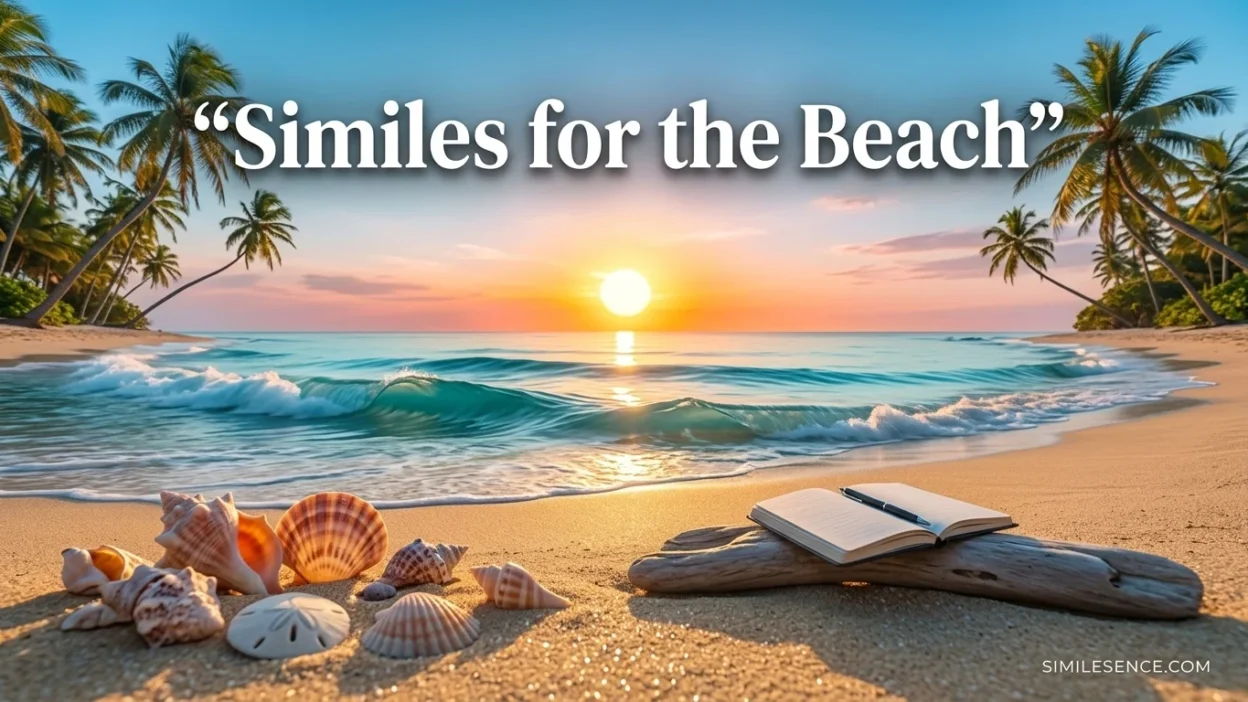
The beach is full of sights, sounds, and feelings. You can hear waves crashing, feel warm sand beneath your feet, and watch the sun shine over the water. But how can you describe all of this in a way that makes your reader feel like they are there? That is where similes for the beach can help.
A simile compares two different things using words such as “like” or “as.” For example, you might say, “The waves rolled like silver ribbons across the shore.” This gives the reader a clear picture instead of simply saying that the waves were beautiful.
In simple terms, similes turn ordinary descriptions into colorful images. They are useful in stories, poems, travel writing, school assignments, and creative writing. You might say the sand is “as soft as velvet” or the ocean is “like a giant blue mirror.”
Let’s explore 20 creative beach similes, their meanings, and simple examples you can use in your own writing.
20 Similes for the Beach
1. The beach was like a golden blanket
Simile: “The beach looked like a golden blanket beneath the sun.”
Meaning: The warm sand covered the shore like a soft golden covering.
What it conveys: This creates a warm, peaceful, and inviting image.
Examples:
- The beach stretched like a golden blanket along the coast.
- In the afternoon sun, the sand looked like a golden blanket.
2. The waves crashed like thunder
Simile: “The waves crashed against the rocks like thunder.”
Meaning: The sound of the waves was loud and powerful.
What it conveys: This simile emphasizes the strength and noise of the ocean.
Examples:
- The waves roared like thunder during the storm.
- Huge waves crashed like thunder against the shore.
3. The sand was as soft as velvet
Simile: “The sand was as soft as velvet beneath my feet.”
Meaning: The sand felt very smooth and soft.
What it conveys: It helps readers imagine the pleasant texture of warm beach sand.
Examples:
- The fine sand felt as soft as velvet.
- Her toes sank into sand as soft as velvet.
4. The ocean was like a giant mirror
Simile: “The calm ocean looked like a giant mirror.”
Meaning: The smooth water reflected the sky and sunlight.
What it conveys: This creates an image of a peaceful and still sea.
Examples:
- At sunrise, the ocean looked like a giant mirror.
- The quiet sea shone like a giant mirror.
5. The waves danced like children
Simile: “The waves danced like happy children along the shore.”
Meaning: The waves moved playfully back and forth.
What it conveys: This makes the ocean seem cheerful and full of life.
Examples:
- Small waves danced like children around our feet.
- The waves danced like happy children in the morning light.
6. The sun was as bright as a diamond
Simile: “The sun was as bright as a diamond above the beach.”
Meaning: The sunlight was extremely bright.
What it conveys: It highlights the strong, sparkling light of a sunny beach day.
Examples:
- The summer sun was as bright as a diamond.
- Sunlight sparkled on the water like a diamond.
7. The sea breeze was like a gentle kiss
Simile: “The sea breeze felt like a gentle kiss on my face.”
Meaning: The breeze was soft and pleasant.
What it conveys: It creates a calm and comforting feeling.
Examples:
- The cool breeze felt like a gentle kiss.
- A soft sea breeze brushed my face like a gentle kiss.
8. The palm trees swayed like dancers
Simile: “The palm trees swayed like dancers in the wind.”
Meaning: The trees moved gracefully from side to side.
What it conveys: This gives the beach a lively and beautiful atmosphere.
Examples:
- The palm trees moved like dancers in the evening breeze.
- Tall palms swayed like graceful dancers above us.
9. The sunset was like a painting
Simile: “The beach sunset looked like a beautiful painting.”
Meaning: The colors of the sunset were bright and beautiful.
What it conveys: It emphasizes the artistic beauty of the evening sky.
Examples:
- The sunset spread across the sky like a painting.
- The colorful horizon looked like a painting made by nature.
10. The shells were like tiny treasures
Simile: “The seashells scattered across the sand were like tiny treasures.”
Meaning: The shells were small, beautiful, and valuable-looking.
What it conveys: This creates a sense of discovery and wonder.
Examples:
- We searched the beach for shells like tiny treasures.
- Each shell looked like a tiny treasure hidden in the sand.
11. The ocean stretched like an endless blue blanket
Simile: “The ocean stretched like an endless blue blanket toward the horizon.”
Meaning: The ocean seemed to cover a huge area.
What it conveys: It shows the vastness and beauty of the sea.
Examples:
- The sea spread like an endless blue blanket before us.
- From the cliff, the ocean looked like an endless blue blanket.
12. The seagulls flew like white arrows
Simile: “The seagulls flew like white arrows across the sky.”
Meaning: The birds moved quickly through the air.
What it conveys: This creates a sharp image of fast and graceful movement.
Examples:
- Seagulls flew like white arrows above the waves.
- The birds rushed across the sky like white arrows.
13. The water sparkled like diamonds
Simile: “The water sparkled like diamonds under the sunlight.”
Meaning: Sunlight reflected brightly from the surface of the sea.
What it conveys: This makes the ocean appear bright, magical, and beautiful.
Examples:
- The waves glittered like diamonds in the morning sun.
- Blue water sparkled like diamonds around the boat.
14. The beach was as peaceful as a quiet garden
Simile: “The empty beach was as peaceful as a quiet garden.”
Meaning: The beach was calm and free from noise.
What it conveys: It creates a relaxing and peaceful mood.
Examples:
- Early in the morning, the beach was as peaceful as a quiet garden.
- The quiet shore felt as peaceful as a hidden garden.
15. The waves were like rolling mountains
Simile: “The waves rose like rolling mountains in the distance.”
Meaning: The waves were large and powerful.
What it conveys: This shows the impressive size and movement of the ocean.
Examples:
- Huge waves rose like rolling mountains beyond the shore.
- The storm pushed waves forward like rolling mountains.
16. The beach smelled like fresh rain
Simile: “The salty air smelled fresh like rain.”
Meaning: The air had a clean and refreshing quality.
What it conveys: It gives the reader a sense of the fresh atmosphere near the sea.
Examples:
- The cool sea air felt fresh like rain.
- After the storm, the beach smelled fresh like rain.
17. The sand was as warm as a blanket
Simile: “The sand was as warm as a blanket beneath us.”
Meaning: The sun had heated the sand to a comfortable warmth.
What it conveys: This creates a cozy and relaxing beach image.
Examples:
- We rested on sand as warm as a blanket.
- The afternoon sand felt as warm as a blanket.
18. The shore curved like a crescent moon
Simile: “The shore curved like a crescent moon around the bay.”
Meaning: The beach had a curved shape similar to a crescent moon.
What it conveys: It helps readers picture the shape of the coastline.
Examples:
- The sandy shore curved like a crescent moon.
- From above, the beach looked like a crescent moon.
19. The ocean sounded like a lullaby
Simile: “The gentle waves sounded like a lullaby.”
Meaning: The sound of the waves was soothing and relaxing.
What it conveys: This creates a peaceful, sleepy atmosphere.
Examples:
- The waves whispered like a lullaby as we rested.
- The sound of the sea was like a gentle lullaby.
20. The beach was as colorful as a rainbow
Simile: “The beach was as colorful as a rainbow.”
Meaning: The beach had many bright colors from umbrellas, towels, boats, and the sunset.
What it conveys: It creates a cheerful and lively picture.
Examples:
- The busy beach looked as colorful as a rainbow.
- Bright umbrellas made the shore as colorful as a rainbow.
How to Use Similes for the Beach in Writing
When using beach similes, think about what you want your reader to see, hear, smell, or feel. A strong simile connects the beach to something familiar.
For example, instead of writing:
“The ocean was beautiful.”
You could write:
“The ocean sparkled like diamonds under the morning sun.”
The second sentence gives the reader a picture they can imagine.
You can also use similes to create different moods. For a peaceful scene, try something like “The waves sounded like a lullaby.” For an exciting scene, you could write, “The waves crashed like thunder.”
This is an easy way to learn how to use similes in writing. Start with something you notice, then ask yourself what it reminds you of. That simple question can lead to creative writing similes.
Practical Exercise: Test Your Simile Skills
Try these questions yourself before looking at the answers.
Questions
- Complete the simile: “The sand was as soft as ______.”
- Which simile best describes a calm ocean?
- A. The ocean was like a giant mirror.
- B. The ocean crashed like thunder.
- C. The ocean roared like a lion.
- Complete the sentence: “The waves crashed like ______.”
- What does “the water sparkled like diamonds” mean?
- Which simile describes palm trees moving in the wind?
- A. Palm trees stood like statues.
- B. Palm trees swayed like dancers.
- C. Palm trees slept like babies.
- Complete the simile: “The ocean stretched like an endless ______.”
- What does “the ocean sounded like a lullaby” suggest?
- Which simile helps describe the shape of a beach?
- A. The shore curved like a crescent moon.
- B. The shore sounded like music.
- C. The shore smelled like rain.
- Create your own simile describing a beach sunset.
- Write one simile describing the feeling of warm sand beneath your feet.
Answers and Explanations
- Velvet. “The sand was as soft as velvet” compares the smooth texture of sand with soft velvet.
- A. The ocean was like a giant mirror. A mirror suggests smooth, still water that reflects light.
- Thunder. “The waves crashed like thunder” shows that the waves are loud and powerful.
- It means the sunlight is reflecting from the water in a bright, sparkling way.
- B. Palm trees swayed like dancers. The comparison shows graceful movement in the wind.
- Blue blanket. This comparison shows how wide and vast the ocean looks.
- It suggests that the sound of the waves is soft, gentle, and relaxing.
- A. The shore curved like a crescent moon. This comparison helps readers picture the curved shape of the coastline.
- Answers will vary. For example: “The beach sunset looked like a giant orange painting.” It compares the colorful sunset with a painting.
- Answers will vary. For example: “The sand felt like warm silk beneath my feet.” This shows that the sand feels smooth and comfortable.
Conclusion
Similes make beach descriptions more vivid, interesting, and easy to imagine. Instead of simply telling your reader that the sand is soft or the ocean is beautiful, you can create a stronger picture with a comparison.
For example, “The sand was as soft as velvet” gives the reader a sense of texture, while “The waves crashed like thunder” helps them imagine the powerful sound of the sea.
The best similes for the beach use familiar things to describe what we see, hear, touch, and feel. As you practice, look at the world around you and ask what each sight or sound reminds you of.
Try creating your own simile sentences, and do not be afraid to experiment. A simple comparison can turn an ordinary beach description into something your readers will remember.

John Kyle is a passionate writer specializing in similes, idioms, metaphors, and figurative language. He creates clear, engaging, and educational content that helps readers understand and confidently use English expressions.