
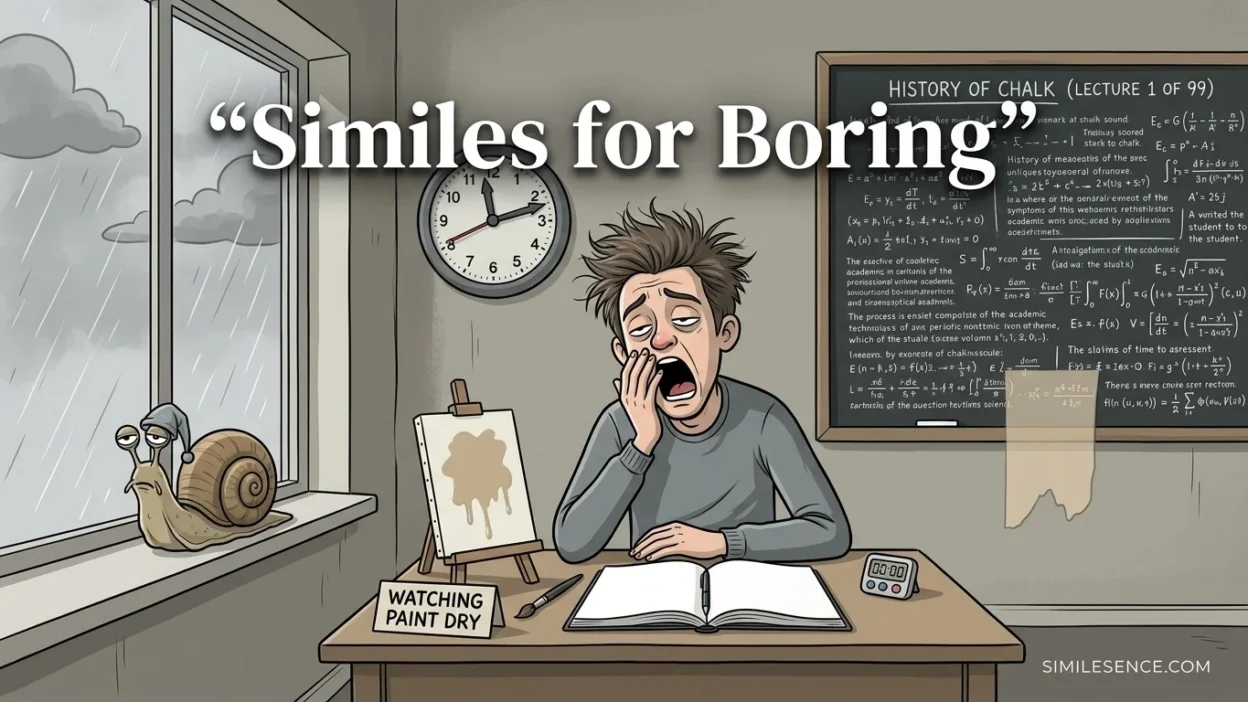
Have you ever watched a movie that seemed to last forever, sat through a long meeting, or read a book that made you want to fall asleep? When something is extremely dull, simply saying “it was boring” may not fully express how you feel. This is where similes for boring can make your writing much more interesting.
A simile compares one thing to another using words such as “like” or “as.” Instead of saying, “The lecture was boring,” you might say, “The lecture was as exciting as watching paint dry.” Suddenly, the reader gets a much clearer picture.
In simple terms, similes help turn ordinary descriptions into colorful ones. They are useful in stories, essays, conversations, poems, social media captions, and everyday writing.
In this guide, let’s explore 20 creative writing similes for boring. Each example includes its meaning and simple simile sentences so you can see exactly how to use it in writing.
20 Similes for Boring
1. As boring as watching paint dry
Meaning: Extremely dull and uninteresting.
This is one of the most common ways to describe something that feels painfully slow or uneventful.
Examples:
- The meeting was as boring as watching paint dry.
- That documentary was as boring as watching paint dry.
2. As dull as a cloudy day
Meaning: Lacking excitement, energy, or interest.
This simile compares boredom to a gray, gloomy day when nothing exciting seems to happen.
Examples:
- The party was as dull as a cloudy day.
- His speech was as dull as a cloudy day.
3. Like watching grass grow
Meaning: Extremely slow and boring.
You might say this when something takes a long time and offers almost no excitement.
Examples:
- Waiting for the computer to update was like watching grass grow.
- The game was like watching grass grow.
4. As exciting as a blank wall
Meaning: Completely uninteresting.
A blank wall gives you almost nothing to look at, making it a useful comparison for something dull.
Examples:
- The lecture was as exciting as a blank wall.
- His story was as exciting as a blank wall.
5. Like listening to a broken record
Meaning: Repetitive and boring.
This simile works especially well when someone keeps saying the same thing again and again.
Examples:
- Listening to him complain was like listening to a broken record.
- The teacher’s repeated instructions were like listening to a broken record.
6. As boring as an empty room
Meaning: Very quiet, lifeless, and uninteresting.
An empty room can feel lifeless, so it makes a simple comparison for boring situations.
Examples:
- The office was as boring as an empty room.
- The event felt as boring as an empty room.
7. Like reading the same page over and over
Meaning: Repetitive and tiring.
This comparison describes an activity that never seems to change or become interesting.
Examples:
- Studying the same topic all afternoon was like reading the same page over and over.
- His explanation was like reading the same page over and over.
8. As dull as a dusty old book
Meaning: Extremely uninteresting or outdated.
This simile creates an image of something old, forgotten, and lacking excitement.
Examples:
- The presentation was as dull as a dusty old book.
- The conversation was as dull as a dusty old book.
9. Like sitting in a waiting room
Meaning: Slow, quiet, and boring.
Waiting rooms are often associated with long periods of doing nothing.
Examples:
- The afternoon felt like sitting in a waiting room.
- The party was like sitting in a waiting room.
10. As lifeless as a dead battery
Meaning: Having no energy or excitement.
A dead battery cannot provide power, making it a strong comparison for something completely lacking energy.
Examples:
- The concert was as lifeless as a dead battery.
- His presentation was as lifeless as a dead battery.
11. Like listening to static
Meaning: Difficult to enjoy because it is repetitive or meaningless.
Static has no clear message or interesting content, making it a useful comparison for boring speech or sounds.
Examples:
- His long explanation was like listening to static.
- The lecture sounded like listening to static.
12. As boring as counting grains of sand
Meaning: Extremely tedious and unexciting.
Counting individual grains of sand would take forever, so this simile emphasizes extreme boredom.
Examples:
- Filling out those forms was as boring as counting grains of sand.
- The task was as boring as counting grains of sand.
13. Like a song played too many times
Meaning: Repetitive and no longer enjoyable.
This works well when something was once enjoyable but has become boring through repetition.
Examples:
- His jokes were like a song played too many times.
- The repeated lesson felt like a song played too many times.
14. As flat as a pancake
Meaning: Lacking excitement, energy, or emotion.
Although “flat as a pancake” can describe physical shape, it can also describe writing, conversations, or performances that feel lifeless.
Examples:
- The story was as flat as a pancake.
- His performance was as flat as a pancake.
15. Like a snail crawling across a road
Meaning: Moving extremely slowly.
This comparison is useful when boredom comes from waiting for something to happen.
Examples:
- The afternoon passed like a snail crawling across a road.
- The meeting moved like a snail crawling across a road.
16. As dry as old toast
Meaning: Uninteresting, lifeless, or lacking excitement.
Dry toast is plain and difficult to enjoy, making it a fun comparison for dull writing or conversation.
Examples:
- His speech was as dry as old toast.
- The article was as dry as old toast.
17. Like a broken clock
Meaning: Repetitive, predictable, or lacking movement.
A broken clock stays stuck, which makes it a useful image for something that feels unchanged.
Examples:
- The discussion was like a broken clock.
- The class felt like a broken clock stuck on the same lesson.
18. As dull as an old newspaper
Meaning: Uninteresting and lacking freshness.
This simile can describe information, conversations, stories, or activities that feel outdated.
Examples:
- The presentation was as dull as an old newspaper.
- His conversation was as dull as an old newspaper.
19. Like a long road with no turns
Meaning: Predictable, repetitive, and lacking surprises.
A straight road with no changes can represent an experience that becomes tiring because nothing unexpected happens.
Examples:
- The movie was like a long road with no turns.
- The story felt like a long road with no turns.
20. As boring as a dripping tap
Meaning: Annoyingly repetitive and dull.
The constant sound of a dripping tap can become tiring, making this a vivid way to describe boring repetition.
Examples:
- His complaints were as boring as a dripping tap.
- The lecture became as boring as a dripping tap.
How to Use Similes for Boring in Writing
The best similes do more than replace the word “boring.” They help readers experience the feeling themselves.
For example:
Basic sentence:
The class was boring.
With a simile:
The class was as boring as watching paint dry.
The second sentence creates a stronger mental picture. Readers can imagine sitting there and waiting for something interesting to happen.
When choosing a simile, think about the kind of boredom you want to show. Is something slow? Repetitive? Lifeless? Predictable? Exhausting? Choose a comparison that matches that feeling.
You might say a meeting was like watching grass grow if it was painfully slow. On the other hand, you could describe a speech as as dry as old toast if the problem was its lack of energy.
This is the real value of creative writing similes: they give ordinary feelings a clear image.
Practical Exercise: Test Your Simile Skills
Try these questions before checking the answers.
Questions
1. Complete the simile:
The lecture was as boring as ________.
a) a fireworks show
b) watching paint dry
c) a roller coaster
2. Which simile best describes something moving very slowly?
a) Like watching grass grow
b) Like a shooting star
c) Like a racing car
3. Complete the sentence:
The speech was as dry as ________.
a) fresh rain
b) old toast
c) a swimming pool
4. Which simile suggests something repetitive?
a) Like listening to a broken record
b) Like flying a kite
c) Like opening a gift
5. True or false:
A simile usually uses words such as “like” or “as.”
6. Complete the sentence:
The afternoon felt like ________.
a) sitting in a waiting room
b) winning a race
c) riding a roller coaster
7. Which simile best describes something with no energy?
a) As lifeless as a dead battery
b) As bright as the sun
c) As quick as lightning
8. Create your own simile:
The boring movie was like __________.
9. Complete the comparison:
The task was as boring as counting ________.
a) stars during a meteor shower
b) grains of sand
c) colorful balloons
10. What makes a simile more effective?
a) A clear and relatable comparison
b) Using as many words as possible
c) Making the comparison confusing
Answers and Explanations
1. b) watching paint dry
This is a classic comparison for something extremely boring.
2. a) Like watching grass grow
Grass grows very slowly, so this simile suggests that something feels painfully slow.
3. b) old toast
Old toast is dry and plain, making it a good comparison for dull speech or writing.
4. a) Like listening to a broken record
A broken record repeats the same sound, so it represents repetition.
5. True
Similes commonly use “like” or “as” to compare two different things.
6. a) sitting in a waiting room
Waiting rooms are often associated with long periods of inactivity and boredom.
7. a) As lifeless as a dead battery
A dead battery has no power, so it creates a strong image of something without energy.
8. Example answer:
“The boring movie was like watching a clock move backward.”
There can be many correct answers. The goal is to create a clear comparison that communicates boredom.
9. b) grains of sand
Counting grains of sand would be extremely tedious, making it a strong comparison for a boring task.
10. a) A clear and relatable comparison
A good simile helps readers quickly understand or imagine the feeling being described.
Why Similes Make Writing Better
Similes can make simple writing more memorable. Instead of repeatedly using words such as boring, dull, slow, repetitive, or lifeless, you can create fresh images that show readers exactly what you mean.
For students, similes can make essays and assignments more descriptive. For storytellers, they can help build mood and personality. For bloggers and content creators, they can make explanations easier to visualize.
The key is not to use a simile in every sentence. Too many comparisons can make writing feel crowded. Instead, choose one strong simile when you want to emphasize an important feeling or idea.
In other words, good similes are about quality, not quantity.
Conclusion
Similes are a simple but powerful way to make writing more descriptive and interesting. Instead of simply telling readers that something is boring, you can show them what that boredom feels like.
Expressions such as “as boring as watching paint dry,” “like watching grass grow,” and “as dry as old toast” create clear mental pictures that ordinary descriptions may not provide.
When learning how to use similes in writing, start with everyday experiences. Think about what boredom reminds you of, then connect those two ideas with “like” or “as.”
So, the next time you write a story, essay, caption, or conversation, don’t settle for simply saying “boring.” Try creating your own comparison. A clever simile can turn even the dullest idea into something readers remember.

Henry Gavin is the Administrator of SimileSence, ensuring high-quality content about similes, idioms, and metaphors. He manages daily operations, supports editorial excellence, and helps readers explore figurative language with confidence.