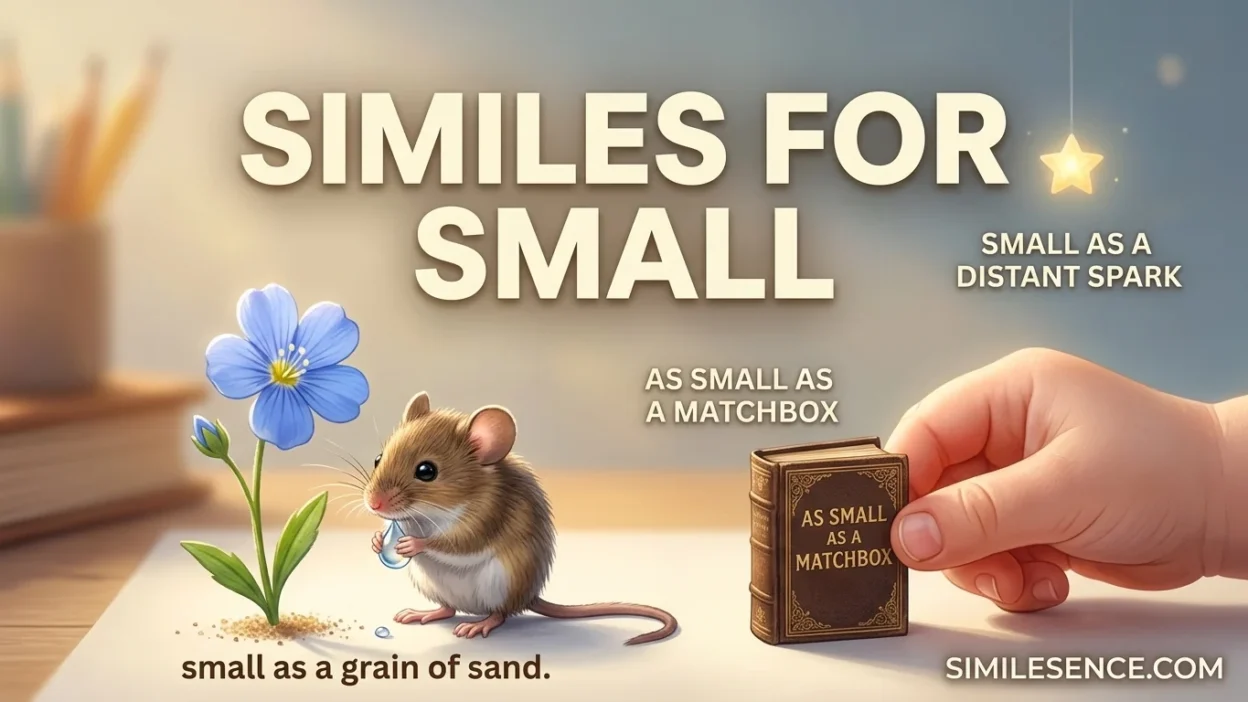
Have you ever wanted to describe something as small but felt that simply saying “tiny” was not enough? That is where similes can help. A simile compares one thing to another using words such as “like” or “as.” It gives readers a clear picture and makes your writing more fun to read.
For example, instead of saying, “The kitten was small,” you might say, “The kitten was as small as a teacup.” Now the reader can imagine just how tiny the kitten is.
In simple terms, similes turn plain descriptions into vivid pictures. They are useful in stories, poems, school assignments, speeches, and everyday writing. When you learn how to use similes in writing, even a simple idea can become more creative.
Let’s explore 20 similes for small that you can use in your own writing. You will also see their meanings, explanations, and simile sentences in context.
20 Similes for Small
1. As small as a button
Simile: The little flower was as small as a button.
Meaning: Extremely small.
What it conveys: This simile helps the reader imagine something tiny by comparing it to a small button.
Examples:
- The new bud was as small as a button.
- He found an insect as small as a button on the leaf.
2. As small as a pea
Simile: The seed was as small as a pea.
Meaning: Very tiny.
What it conveys: A pea is small and round, so this comparison creates an easy mental picture.
Examples:
- The tiny bead was as small as a pea.
- A green spot appeared, as small as a pea, on the wall.
3. As small as a grain of rice
Simile: The insect was as small as a grain of rice.
Meaning: Extremely tiny.
What it conveys: This comparison shows that something is so small that it could fit beside a single grain of rice.
Examples:
- The writing was as small as a grain of rice.
- We spotted an egg as small as a grain of rice.
4. As small as a seed
Simile: The village looked as small as a seed from the mountain.
Meaning: Very small when compared with something larger.
What it conveys: It creates a strong sense of distance and tiny size.
Examples:
- From the airplane, the houses looked as small as seeds.
- The tiny island appeared as small as a seed in the ocean.
5. As small as a marble
Simile: The colorful stone was as small as a marble.
Meaning: Small and compact.
What it conveys: This simile gives the reader a familiar object to use as a size reference.
Examples:
- She found a shell as small as a marble.
- The toy ball was as small as a marble.
6. As small as a coin
Simile: The patch of sunlight was as small as a coin.
Meaning: Limited in size.
What it conveys: A coin provides a simple and familiar picture of something relatively small.
Examples:
- The hole was as small as a coin.
- A circle of light appeared as small as a coin on the floor.
7. Like a tiny speck
Simile: The boat looked like a tiny speck on the horizon.
Meaning: Extremely small and distant.
What it conveys: This comparison shows how something can appear almost invisible because of its distance.
Examples:
- The plane looked like a tiny speck in the sky.
- From the hill, the car looked like a tiny speck.
8. As small as a thumbnail
Simile: The painting was as small as a thumbnail.
Meaning: Very small.
What it conveys: A thumbnail is a familiar example of a small surface, making the comparison easy to understand.
Examples:
- The photograph was as small as a thumbnail.
- He drew a picture as small as a thumbnail.
9. Like a tiny dot
Simile: The star looked like a tiny dot in the dark sky.
Meaning: Extremely small in appearance.
What it conveys: This simile shows how something appears very small against a large background.
Examples:
- The bird looked like a tiny dot above the trees.
- The distant house looked like a tiny dot.
10. As small as a button on a shirt
Simile: The spider was as small as a button on a shirt.
Meaning: Very tiny.
What it conveys: This detailed comparison makes the size easier for readers to visualize.
Examples:
- The little shell was as small as a button on a shirt.
- I noticed a bug as small as a button on my sleeve.
11. Like a tiny pebble
Simile: The object felt like a tiny pebble in my hand.
Meaning: Small and hard.
What it conveys: This simile can describe both the size and physical feel of an object.
Examples:
- The seed felt like a tiny pebble.
- The piece of clay looked like a tiny pebble.
12. As small as a fingernail
Simile: The picture was as small as a fingernail.
Meaning: Very small in size.
What it conveys: It gives readers a clear physical comparison that is easy to picture.
Examples:
- The sticker was as small as a fingernail.
- He found a mark as small as a fingernail.
13. Like a little drop of water
Simile: The tiny bead looked like a little drop of water.
Meaning: Small, round, and delicate.
What it conveys: This comparison gives the object a delicate and gentle quality.
Examples:
- The crystal looked like a little drop of water.
- A tiny pearl sat in her hand like a little drop of water.
14. As small as a crumb
Simile: The piece of paper was as small as a crumb.
Meaning: Extremely small.
What it conveys: A crumb is a tiny leftover piece, so it is useful when describing something very small.
Examples:
- The piece of cheese was as small as a crumb.
- He noticed a piece of dust as small as a crumb.
15. Like a tiny button
Simile: The moon looked like a tiny button in the morning sky.
Meaning: Small and round in appearance.
What it conveys: This creates a simple visual image of something appearing tiny against a larger background.
Examples:
- The balloon looked like a tiny button from far away.
- The distant moon looked like a tiny button.
16. As small as a match head
Simile: The spark was as small as a match head.
Meaning: Very tiny.
What it conveys: This comparison gives the reader a clear idea of a very small object.
Examples:
- The mark was as small as a match head.
- A tiny spot appeared as small as a match head.
17. Like a tiny grain
Simile: The sand-colored stone looked like a tiny grain.
Meaning: Very small.
What it conveys: It suggests something so small that it could easily be mistaken for a single grain.
Examples:
- The seed looked like a tiny grain on the table.
- The speck of sand was like a tiny grain of gold.
18. As small as a ladybug
Simile: The little robot was as small as a ladybug.
Meaning: Small enough to fit easily in your hand.
What it conveys: This comparison makes the size easy to imagine while adding a playful feeling.
Examples:
- The toy was as small as a ladybug.
- We saw a creature as small as a ladybug hiding under the leaf.
19. Like a tiny star
Simile: The distant light looked like a tiny star.
Meaning: Small and bright.
What it conveys: This simile describes something that is not only small but also noticeable because it shines.
Examples:
- The lamp looked like a tiny star across the valley.
- A candle flickered like a tiny star in the darkness.
20. As small as a buttonhole
Simile: The opening was as small as a buttonhole.
Meaning: Very narrow and small.
What it conveys: This comparison works well when describing a tiny opening or narrow space.
Examples:
- The crack was as small as a buttonhole.
- Light entered through a gap as small as a buttonhole.
How to Use Similes for Small in Writing
When you use similes, think about the exact feeling or picture you want to create. Do you want your subject to seem cute, delicate, distant, weak, or almost invisible?
For example, “as small as a pea” works well for something tiny and simple. On the other hand, “like a tiny speck on the horizon” is better when you want to show distance.
You might say:
- The puppy was as small as a pea.
- The ship looked like a tiny speck.
- Her drawing was as small as a thumbnail.
Good creative writing similes do more than describe size. They help readers see the scene in their minds.
Practical Exercise: Test Your Simile Skills
Try answering these questions before checking the answers.
Questions
1. Complete the simile:
The tiny seed was as small as a ______.
2. Which simile best describes something that is very distant?
A. As small as a button
B. Like a tiny speck on the horizon
C. As small as a pea
3. Complete the sentence:
The bead was ______ a marble.
4. What does “as small as a grain of rice” mean?
5. Which word is commonly used to connect a simile?
A. Like
B. Because
C. Although
6. Turn this sentence into a simile:
“The insect was very small.”
7. Which simile best describes something small and bright?
A. Like a tiny star
B. As small as a crumb
C. Like a tiny pebble
8. What does “as small as a button” help the reader understand?
9. Complete the simile:
The tiny mark was as small as a ______.
10. Create your own simile for something very small.
Answers and Explanations
1. Answer: A pea, seed, button, or another suitable tiny object.
The goal is to compare the seed with something familiar and small.
2. Answer: B. Like a tiny speck on the horizon.
This simile shows that something appears tiny because it is far away.
3. Answer: Like.
The complete sentence is: “The bead was like a marble.”
4. Answer: It means something is extremely tiny.
A grain of rice gives the reader a simple size comparison.
5. Answer: A. Like.
“Like” is one of the most common words used to create similes.
6. Example answer: “The insect was as small as a grain of rice.”
The comparison makes the insect’s size easier to imagine.
7. Answer: A. Like a tiny star.
A star can suggest something that is both small in appearance and bright.
8. Answer: It shows that the object is very small.
A button is a familiar object, so readers can quickly picture its size.
9. Answer: A match head, crumb, pea, or similar tiny object.
Several answers can work as long as the comparison clearly shows small size.
10. Example answer: “The tiny shell was as small as a pea.”
Your own answer can be different. The key is to make the comparison clear and easy to picture.
Conclusion
Similes are a simple but powerful way to make writing more vivid. Instead of only telling readers that something is small, you can show its size through a familiar comparison. That makes your words easier to picture and more enjoyable to read.
From “as small as a pea” to “like a tiny speck on the horizon,” these examples of similes can help you describe size in creative ways. Remember, there is no need to make every comparison complicated. The best simile is often the one that gives your reader the clearest picture.
So, the next time you need to describe something tiny, try creating your own simile. Think of a small object you know well, compare it to your subject, and see how much more colorful your writing becomes.

James Jason is a passionate language writer specializing in similes, idioms, metaphors, and figurative expressions. He creates clear, engaging, and educational content that helps readers understand language, improve communication, and enjoy the beauty of English.