
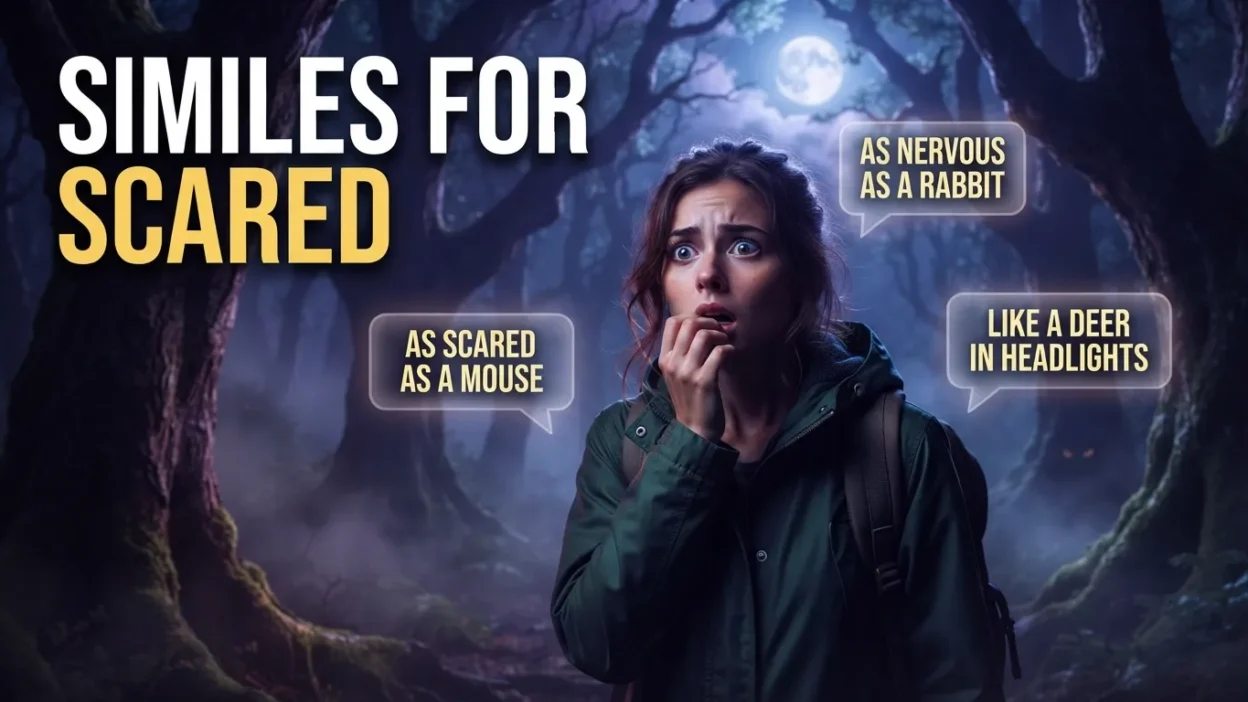
Have you ever wanted to describe fear without using the same words over and over? Instead of saying someone was scared, afraid, or terrified, you can use similes for scared to create a stronger picture in your reader’s mind. A good simile turns a simple sentence into one that feels real and memorable.
For example, rather than writing, “The boy was scared,” you might say, “The boy stood like a deer caught in headlights.” Instantly, readers can imagine exactly how he feels. That’s the power of similes.
If you’re a student completing an English assignment, a teacher looking for classroom examples, or a writer improving your storytelling, this guide has everything you need. You’ll discover the meaning of similes, learn how to use similes in writing, explore creative writing similes, and see plenty of simile sentences you can use right away.
Let’s explore the best scared similes with easy explanations, practical examples, and writing tips.
Quick Answer:
If you’re looking for a quick answer, here are some of the most common similes for scared:
- As scared as a mouse in a room full of cats
- Like a deer caught in headlights
- As pale as a ghost
- Like a leaf in the wind
- As nervous as a rabbit near a fox
- As still as a statue
- Like a bird trapped in a cage
- As shaky as jelly
- Like a child lost in a crowd
- As frightened as a lamb
These examples of similes compare fear to familiar situations, making emotions easier to picture in stories, essays, poems, and everyday writing.
What Are Similes?
A simile is a figure of speech that compares two different things using the words like or as.
Instead of simply describing something, a simile helps readers imagine it through comparison.
Simple Simile Examples
- As brave as a lion
- As busy as a bee
- Like the wind
- As cold as ice
- As pale as a ghost
These simile examples are easy to understand because they compare one thing with another that people already know.
Meaning of Similes
The meaning of similes is simple. They make descriptions clearer and more interesting by comparing two unlike things.
For example:
Instead of saying:
She was scared.
You could write:
She was as pale as a ghost.
The second sentence creates a much stronger image.
Why Use Similes in Writing?
Learning how to use similes in writing helps you become a better writer. Similes add emotion, detail, and creativity to your work.
Good creative writing similes can:
- Make readers picture a scene.
- Show emotions instead of simply telling them.
- Improve stories and essays.
- Make writing easier to remember.
- Add color to descriptive paragraphs.
- Strengthen simile sentences.
- Improve storytelling for students and writers.
Whether you’re writing fiction, poetry, or school assignments, similes in writing make every sentence more engaging.
Show, Don’t Tell: Why Similes Work
One of the best writing tips is to show, don’t tell.
Instead of telling readers someone is scared, show them through a comparison.
| Don’t Tell | Show with a Simile |
| He was scared. | He stood like a deer caught in headlights. |
| She was nervous. | She shook like a leaf in the wind. |
| They were frightened. | They were as still as statues. |
| The child felt afraid. | The child looked as frightened as a lamb. |
This simple technique makes your writing much more vivid.
Simile vs. Metaphor
Many people confuse similes with metaphors.
Here’s the difference.
| Simile | Metaphor |
| Uses like or as | Does not use like or as |
| As pale as a ghost | Fear was a ghost beside her |
| Like a deer caught in headlights | He became a statue |
| Easier for beginners | More direct comparison |
If you’re just starting, similes are usually easier to write and understand.
When Can You Use Similes for Scared?
These fear similes work in many kinds of writing.
You can use them in:
- Creative writing
- School essays
- English homework
- Short stories
- Poems
- Speeches
- Fiction writing
- Classroom activities
- Storytelling competitions
- Journal writing
Using the right scared comparison examples makes your writing more expressive and enjoyable to read.
Best Similes for Scared with Meanings and Examples
1. As Scared as a Mouse in a Room Full of Cats
Meaning: Extremely frightened because danger feels very close.
Explanation: A mouse surrounded by cats has almost no chance of escaping. This is one of the strongest similes for fear because it shows complete panic.
Example Sentences:
- Jake looked as scared as a mouse in a room full of cats when the principal called his name.
- The tiny puppy was as scared as a mouse in a room full of cats during the thunderstorm.
2. Like a Deer Caught in Headlights
Meaning: Frozen with fear.
Explanation: A deer often freezes when bright headlights shine on it. This is one of the most common similes about fear in English.
Example Sentences:
- She stood like a deer caught in headlights after hearing the loud crash.
- I felt like a deer caught in headlights when everyone stared at me.
3. As Pale as a Ghost
Meaning: So frightened that your face loses its color.
Explanation: Fear often causes someone’s face to become pale, making this one of the oldest and most popular scared similes.
Example Sentences:
- He turned as pale as a ghost after watching the scary movie.
- Emily looked as pale as a ghost before walking onto the stage.
4. Like a Leaf in the Wind
Meaning: Shaking because of fear.
Explanation: Leaves tremble in the wind just as frightened people often shake.
Example Sentences:
- My hands shook like a leaf in the wind before the interview.
- The little girl trembled like a leaf in the wind during the storm.
5. As Nervous as a Rabbit Near a Fox
Meaning: Feeling that danger is close.
Explanation: Rabbits naturally fear foxes, making this one of the easiest examples of similes to understand.
Example Sentences:
- The student felt as nervous as a rabbit near a fox before the exam.
- He looked as nervous as a rabbit near a fox while waiting for the doctor.
6. Like a Bird Trapped in a Cage
Meaning: Feeling frightened and unable to escape.
Explanation: Fear often makes people feel trapped, just like a bird inside a cage.
Example Sentences:
- She felt like a bird trapped in a cage when the elevator stopped.
- I was like a bird trapped in a cage during the power outage.
7. As Shaky as Jelly
Meaning: Trembling because of fear.
Explanation: Jelly wobbles easily, making this comparison simple and memorable.
Example Sentences:
- His legs were as shaky as jelly before the competition.
- I became as shaky as jelly while giving my speech.
8. Like Ice in the Sun
Meaning: Courage disappears very quickly.
Explanation: Just as ice melts in sunlight, confidence melts away when fear takes over.
Example Sentences:
- Her confidence disappeared like ice in the sun.
- My courage melted like ice in the sun before the presentation.
9. As Quiet as a Frightened Kitten
Meaning: Too scared to speak.
Explanation: A frightened kitten often stays silent, making this one of the gentlest creative writing similes.
Example Sentences:
- The child became as quiet as a frightened kitten.
- Everyone sat as quiet as a frightened kitten after hearing the strange sound.
10. Like a Balloon Ready to Burst
Meaning: Filled with fear and nervous tension.
Explanation: This simile compares overwhelming fear to a balloon stretched almost to its limit.
Example Sentences:
- I felt like a balloon ready to burst before the driving test.
- He looked like a balloon ready to burst while waiting for the results.
Tips from Creative Writing Teachers
Professional writers often use similes to help readers connect with emotions. Here are a few expert tips:
- Choose comparisons your readers already understand.
- Keep similes short and natural.
- Avoid using the same simile too often.
- Match the simile to the mood of your story.
- Read your sentence aloud to see if it sounds smooth.
- Try creating original similes instead of relying only on common ones.
These tips will help you write stronger descriptive writing similes and improve your storytelling.
11. As Still as a Statue
Meaning: Frozen with fear and unable to move.
Explanation: A statue never moves, so this simile perfectly describes someone who is completely frozen because of fear. It is one of the most common similes for scared in English.
Example Sentences:
- The children stood as still as a statue when they heard footsteps outside.
- I became as still as a statue after seeing the snake.
12. Like a Fish Out of Water
Meaning: Feeling uncomfortable, lost, or scared in a new situation.
Explanation: A fish cannot survive outside water, so this comparison shows fear, confusion, and discomfort.
Example Sentences:
- On my first day at school, I felt like a fish out of water.
- He looked like a fish out of water during the interview.
13. As Jumpy as a Cat
Meaning: Easily frightened by every sound or movement.
Explanation: Cats quickly react to unexpected noises, making this one of the easiest simile examples for students.
Example Sentences:
- She became as jumpy as a cat after watching the horror movie.
- The campers were as jumpy as a cat when they heard a twig snap.
14. Like a Candle in the Wind
Meaning: Feeling weak, uncertain, and frightened.
Explanation: A candle flame can disappear at any moment, just as courage can fade when fear takes over.
Example Sentences:
- His confidence was like a candle in the wind before the interview.
- She felt like a candle in the wind during the storm.
15. As Tense as a Stretched Rubber Band
Meaning: Filled with fear and nervous energy.
Explanation: A stretched rubber band is tight and ready to snap, just like someone feeling extreme anxiety.
Example Sentences:
- I was as tense as a stretched rubber band before the speech.
- The players looked as tense as a stretched rubber band before the championship game.
16. Like a Child Lost in a Crowd
Meaning: Feeling frightened, confused, and alone.
Explanation: This simile creates a vivid picture of fear mixed with uncertainty.
Example Sentences:
- She felt like a child lost in a crowd at the airport.
- I looked like a child lost in a crowd inside the huge shopping mall.
17. As Frightened as a Lamb
Meaning: Gentle, innocent, and very scared.
Explanation: Lambs often symbolize innocence, making this one of the best similes about fear.
Example Sentences:
- The little boy looked as frightened as a lamb.
- She stood as frightened as a lamb while waiting for the dentist.
18. Like a Boat in a Storm
Meaning: Overwhelmed by fear and uncertainty.
Explanation: A small boat struggles in rough water, just as people struggle with fear.
Example Sentences:
- My thoughts felt like a boat in a storm before the competition.
- She was like a boat in a storm after hearing the unexpected news.
19. As Cold as Ice
Meaning: Fear makes the body feel cold.
Explanation: Many people experience chills when they become frightened.
Example Sentences:
- My hands became as cold as ice after the loud bang.
- He felt as cold as ice when the lights suddenly went out.
20. Like Someone Walking Through a Haunted House
Meaning: Constantly expecting something scary to happen.
Explanation: This modern comparison paints a vivid picture and works well in creative writing similes.
Example Sentences:
- She walked like someone walking through a haunted house, listening to every sound.
- I felt like someone walking through a haunted house during the blackout.
Similes for Scared at a Glance
| Simile | Meaning | Best Used For |
| As scared as a mouse in a room full of cats | Extreme fear | Panic |
| Like a deer caught in headlights | Frozen with fear | Shock |
| As pale as a ghost | Face loses color | Sudden fear |
| Like a leaf in the wind | Shaking | Nervousness |
| As nervous as a rabbit near a fox | Feeling danger | Anxiety |
| Like a bird trapped in a cage | Feeling trapped | Stress |
| As shaky as jelly | Trembling | Public speaking |
| Like ice in the sun | Losing courage | Worry |
| As quiet as a frightened kitten | Too scared to speak | Silence |
| Like a balloon ready to burst | Overwhelming tension | Pressure |
| As still as a statue | Frozen | Fear |
| Like a fish out of water | Feeling out of place | New situations |
| As jumpy as a cat | Easily startled | Suspense |
| Like a candle in the wind | Weak courage | Uncertainty |
| As tense as a stretched rubber band | Extreme tension | Stress |
| Like a child lost in a crowd | Confused and scared | Loneliness |
| As frightened as a lamb | Gentle fear | Innocence |
| Like a boat in a storm | Emotional fear | Difficult situations |
| As cold as ice | Chilled by fear | Sudden shock |
| Like someone walking through a haunted house | Expecting danger | Suspense |
How to Write Your Own Similes for Scared
Creating original scared similes is easier than you might think.
Step 1: Choose the Emotion
Think about what kind of fear you want to describe.
- Nervous
- Terrified
- Startled
- Worried
- Anxious
Step 2: Think of Something Similar
Ask yourself:
“What behaves like this feeling?”
For example:
- A leaf shaking
- A rabbit running
- A candle flickering
- A bird trapped in a cage
Step 3: Use “Like” or “As”
Examples:
- Like a bird in a storm
- As frightened as a lamb
- Like a balloon ready to burst
Step 4: Keep It Simple
The best simile sentences are short, natural, and easy to imagine.
Step 5: Read It Aloud
If it sounds smooth and creates a clear picture, your simile works.
Common Synonyms for Scared
Knowing related words helps you choose the right simile.
- Afraid
- Frightened
- Terrified
- Nervous
- Anxious
- Alarmed
- Startled
- Panicked
- Uneasy
- Fearful
- Worried
- Timid
These words also improve your vocabulary and make your writing more varied.
Common Mistakes When Using Similes
When learning how to use similes in writing, avoid these mistakes:
- Using comparisons that don’t make sense.
- Mixing metaphors and similes together.
- Repeating the same simile many times.
- Making comparisons too long.
- Forgetting to use like or as.
- Choosing clichés when a fresh comparison would work better.
Clear and natural similes in writing always make the strongest impression.
Practice Exercise
Test your understanding with these activities.
Fill in the Blank
1. She stood __________ after hearing the loud noise.
2. His hands were __________ before the interview.
3. The child felt __________ in the crowded mall.
Multiple Choice
4. Which simile means frozen with fear?
A. Like a fish out of water
B. Like a deer caught in headlights
C. Like ice in the sun
Answer: B
Match the Simile
5. Match each simile to its meaning.
| Simile | Meaning |
| As pale as a ghost | Face loses color |
| Like a leaf in the wind | Trembling |
| As frightened as a lamb | Gentle fear |
Rewrite the Sentence
6. Rewrite this sentence using a simile:
“The girl was scared.”
Possible Answer:
“The girl stood like a deer caught in headlights.”
Create Your Own Simile
7. Write a simile that describes someone feeling nervous before an exam.
Sample Answer:
“I was as shaky as jelly before opening the test paper.”
Answers with Explanations
1. As still as a statue — Fear can make someone freeze.
2. As cold as ice — Fear often causes cold hands.
3. Like a child lost in a crowd — Shows confusion and fear.
4. B. Like a deer caught in headlights — This simile means someone is frozen with fear.
5. The matches show how each simile connects to a specific emotion or physical reaction.
6. Rewriting plain sentences with similes makes writing more descriptive.
7. There are many correct answers as long as the comparison clearly shows fear or nervousness.
Frequently Asked Questions
What is a simile for scared?
A simile for scared compares fear to something familiar using like or as. For example, like a deer caught in headlights or as pale as a ghost.
What are five common similes for fear?
Some popular fear similes include:
- As scared as a mouse in a room full of cats
- Like a deer caught in headlights
- Like a leaf in the wind
- As pale as a ghost
- As frightened as a lamb
What is the difference between a simile and a metaphor?
A simile uses like or as, while a metaphor makes a direct comparison without those words.
Why are similes important in creative writing?
They help readers imagine emotions and scenes more clearly, making stories more vivid and engaging.
Can students use similes in essays?
Yes. Similes make essays, stories, and descriptive writing more interesting when used naturally.
How can I make my own similes?
Think about the emotion, compare it with something familiar, and connect them using like or as.
What are easy similes for beginners?
Examples include as cold as ice, as busy as a bee, like the wind, and as pale as a ghost.
Final Thoughts
Learning similes for scared is one of the easiest ways to improve your descriptive writing. Instead of simply saying someone feels afraid, you can show that emotion through vivid comparisons readers immediately understand. The examples of similes, practical exercises, and writing tips in this guide will help you build stronger storytelling skills and more engaging simile sentences.
Keep practicing by creating your own creative writing similes inspired by everyday life, animals, and nature. The more you experiment with similes in writing, the more natural they will become. If you’re writing a story, completing homework, or improving your English, these scared comparison examples will help your writing stand out.

James Jason is a passionate language writer specializing in similes, idioms, metaphors, and figurative expressions. He creates clear, engaging, and educational content that helps readers understand language, improve communication, and enjoy the beauty of English.