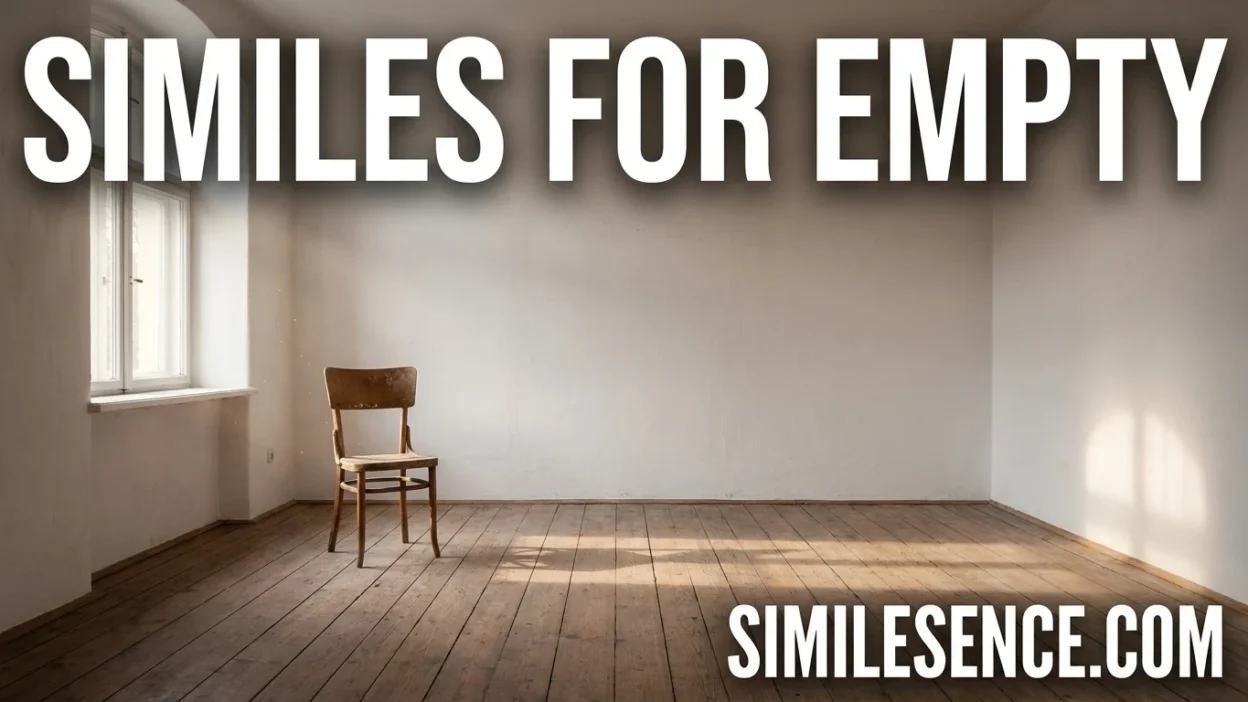
Have you ever walked into a room after everyone has left and felt how quiet and bare it seems? Or opened a box, bag, or cupboard and found nothing inside? Saying something is simply “empty” tells us the fact, but a good simile can help us feel that emptiness.
A simile compares one thing with another using words such as “like” or “as.” For example, “The room was as empty as a desert” gives us a stronger picture than “The room was empty.”
When you use similes for empty, you can show different kinds of emptiness. A place can feel lonely, a container can be completely bare, or a person’s mind can feel blank. In simple terms, similes help readers picture what you mean.
Let’s explore some useful examples of similes for empty spaces, feelings, places, and objects. You can use these creative writing similes in stories, poems, school assignments, or everyday writing.
20 Similes for Empty
1. Empty as a Desert
Simile: The playground was as empty as a desert.
Meaning: The place had almost nobody or nothing in it.
Explanation: A desert can seem wide, quiet, and almost completely empty.
Examples:
- The school hallway was as empty as a desert after the students went home.
- The park looked as empty as a desert on the cold morning.
2. Empty Like an Abandoned House
Simile: The building stood empty like an abandoned house.
Meaning: The building had no people inside.
Explanation: An abandoned house creates a strong image of loneliness and stillness.
Examples:
- The old shop looked empty like an abandoned house.
- The office felt empty like an abandoned house after everyone moved away.
3. Empty as a Blank Page
Simile: My mind felt as empty as a blank page.
Meaning: I could not think of any ideas.
Explanation: A blank page has nothing written on it, making it a useful comparison for an empty mind.
Examples:
- When the teacher asked me to write, my mind felt as empty as a blank page.
- After hours of thinking, his mind remained as empty as a blank page.
4. Empty Like a Hollow Shell
Simile: The old building felt empty like a hollow shell.
Meaning: Something remained, but there was nothing inside it.
Explanation: A hollow shell has an outside structure but no contents inside.
Examples:
- After the furniture was removed, the house felt empty like a hollow shell.
- The factory stood empty like a hollow shell.
5. Empty as an Empty Bottle
Simile: The bottle was as empty as an empty bottle.
Meaning: Something contains absolutely nothing.
Explanation: This simple comparison emphasizes complete emptiness. A better creative version is often “as empty as a bottle with not a drop left.”
Examples:
- The water container was as empty as a bottle with not a drop left.
- His glass was as empty as a bottle after a long picnic.
6. Empty Like a Deserted Street
Simile: The street was empty like a deserted street.
Meaning: There was nobody around.
Explanation: A deserted street creates a strong picture of silence and loneliness.
Examples:
- At midnight, the road was empty like a deserted street.
- The usually busy market became empty like a deserted street after the storm.
7. Empty as a Forgotten Room
Simile: The room was as empty as a forgotten room.
Meaning: The room had very little inside and felt lonely.
Explanation: A forgotten room suggests stillness, silence, and neglect.
Examples:
- The attic was as empty as a forgotten room.
- The old classroom looked as empty as a forgotten room.
8. Empty Like a Dried-Up Well
Simile: The well was empty like a dried-up well.
Meaning: Something had completely lost its contents.
Explanation: A dried-up well gives a clear image of something that once held water but now contains none.
Examples:
- The old water tank was empty like a dried-up well.
- After weeks without rain, the pond looked empty like a dried-up well.
9. Empty as a Vacant Chair
Simile: The corner looked as empty as a vacant chair.
Meaning: A space felt noticeably unoccupied.
Explanation: An unused chair can suggest that someone is missing, giving this comparison an emotional feeling.
Examples:
- The dining table felt as empty as a vacant chair without Grandma.
- His desk looked as empty as a vacant chair after he left.
10. Empty Like a Lifeless Street
Simile: The city looked empty like a lifeless street.
Meaning: The city had very little activity.
Explanation: This comparison emphasizes silence and a lack of movement.
Examples:
- The town became empty like a lifeless street after the festival ended.
- The neighborhood looked empty like a lifeless street during the storm.
11. Empty as a Cave
Simile: The room was as empty as a cave.
Meaning: The room had very few things inside.
Explanation: A bare cave can create an image of a large, quiet, and empty space.
Examples:
- The warehouse was as empty as a cave.
- The new apartment felt as empty as a cave before the furniture arrived.
12. Empty Like a Silent Theater
Simile: The theater was empty like a silent theater after the show.
Meaning: Nobody was left inside.
Explanation: A theater after a performance can suddenly become quiet and vacant.
Examples:
- The hall felt empty like a silent theater after midnight.
- The auditorium looked empty like a silent theater once the crowd left.
13. Empty as the Sky at Midnight
Simile: The playground looked as empty as the sky at midnight.
Meaning: The place seemed completely bare and quiet.
Explanation: This comparison creates a peaceful image of a wide, quiet space.
Examples:
- The field was as empty as the sky at midnight.
- The beach looked as empty as the sky at midnight during the winter.
14. Empty Like a Drained Pool
Simile: The swimming pool looked empty like a drained pool.
Meaning: Something that once held a lot is now completely bare.
Explanation: A drained pool gives a strong visual picture of something that has lost everything inside it.
Examples:
- The tank was empty like a drained pool.
- The fountain stood empty like a drained pool.
15. Empty as a Deserted Classroom
Simile: The classroom was as empty as a deserted classroom.
Meaning: Nobody was inside the room.
Explanation: A classroom normally has students and activity, so its emptiness becomes more noticeable when everyone leaves.
Examples:
- The school was quiet, and the hallway felt as empty as a deserted classroom.
- The room looked as empty as a deserted classroom during the holiday.
16. Empty Like a Shell Without a Pearl
Simile: The box felt empty like a shell without a pearl.
Meaning: Something had nothing valuable or meaningful inside it.
Explanation: A shell without a pearl gives a simple image of something expected to contain something special but containing nothing.
Examples:
- The treasure chest was empty like a shell without a pearl.
- The old box felt empty like a shell without a pearl.
17. Empty as a Bare Shelf
Simile: The cupboard was as empty as a bare shelf.
Meaning: There was almost nothing inside.
Explanation: A bare shelf gives an immediate picture of a space with no objects on it.
Examples:
- The kitchen cupboard was as empty as a bare shelf.
- After moving day, the bookcase looked as empty as a bare shelf.
18. Empty Like a Lonely Road
Simile: The road stretched ahead like a lonely road.
Meaning: The road seemed empty and isolated.
Explanation: This comparison focuses not only on emptiness but also on the lonely feeling it creates.
Examples:
- The highway looked empty like a lonely road in the desert.
- At dawn, the path seemed empty like a lonely road.
19. Empty as a Cloudless Sky
Simile: The sky looked as empty as a cloudless sky.
Meaning: There was nothing visible in the space.
Explanation: A clear sky with no clouds can create a feeling of openness and emptiness.
Examples:
- The huge blue space looked as empty as a cloudless sky.
- The screen seemed as empty as a cloudless sky before the presentation began.
20. Empty Like a Room After Moving Day
Simile: The house looked empty like a room after moving day.
Meaning: Almost everything had been removed.
Explanation: Moving day often leaves rooms completely bare, making this a relatable comparison for emptiness.
Examples:
- The apartment was empty like a room after moving day.
- Their old home felt empty like a room after moving day.
How to Use Similes for Empty in Writing
When writing about emptiness, think about what kind of empty feeling you want to create.
If you want to show physical emptiness, try comparisons such as “as empty as a bare shelf.” If you want to show loneliness, something like “like a deserted street” may work better.
You can also use similes to describe feelings. For example, instead of writing:
“My mind was empty.”
You could write:
“My mind was as empty as a blank page.”
The second sentence gives readers something they can picture. That is what makes simile sentences useful.
You might say that a room is empty, but a creative writer can show whether that room feels peaceful, lonely, forgotten, or completely bare.
Practical Exercise
Try answering these questions before looking at the answers.
Questions
1. Complete the simile:
“My mind was as empty as a ________.”
2. Which comparison best describes a completely bare cupboard?
a) Like a bare shelf
b) Like a crowded market
c) Like a busy train
3. What does “as empty as a desert” suggest?
4. Identify the simile:
“The classroom was empty like a deserted street.”
5. Complete the sentence:
“The swimming pool looked empty like a ________.”
6. What does “empty like a hollow shell” mean?
7. Which simile best describes a place with nobody around?
a) As busy as a market
b) Like a deserted street
c) Like a crowded stadium
8. Find the simile in this sentence:
“His mind felt as empty as a blank page.”
**9. Write your own simile for an empty room.
10. Complete this sentence with a creative comparison:
“After everyone left, the house felt as empty as ________.”
Answers and Explanations
1. Blank page
“My mind was as empty as a blank page.” A blank page has nothing written on it, so it clearly represents a lack of ideas.
2. Like a bare shelf
A bare shelf has nothing sitting on it, making it a clear comparison for an empty cupboard.
3.
It suggests that something is wide, bare, quiet, and almost completely without people or objects.
4.
The simile is “like a deserted street.” It compares the empty classroom to a street where nobody is present.
5. Drained pool
“The swimming pool looked empty like a drained pool.” A drained pool contains no water.
6.
It means something has an outside structure but is empty inside, like a shell with nothing living or valuable within it.
7. Like a deserted street
A deserted street creates a strong image of a place without people.
8.
The simile is “as empty as a blank page.” It compares the person’s empty mind to a page with nothing written on it.
9.
One possible answer is: “The room was as empty as a forgotten house.” Your answer can be different as long as it clearly compares the room to something empty.
10.
One possible answer is: “After everyone left, the house felt as empty as a deserted theater.” This creates a clear image of a once-active place becoming quiet and vacant.
Conclusion
Similes make simple descriptions much more vivid. When you write that something is “empty,” your reader understands the basic idea. But when you compare it to a desert, blank page, bare shelf, deserted street, or hollow shell, the reader can actually picture the emptiness.
The best similes for empty depend on what you want your reader to feel. Some comparisons create loneliness, while others show space, silence, or a complete lack of objects.
As you practice how to use similes in writing, try looking around you for interesting comparisons. Ask yourself what an empty room, box, street, or mind reminds you of. With practice, your own creative writing similes will become more natural, vivid, and memorable.

Henry Gavin is the Administrator of SimileSence, ensuring high-quality content about similes, idioms, and metaphors. He manages daily operations, supports editorial excellence, and helps readers explore figurative language with confidence.