
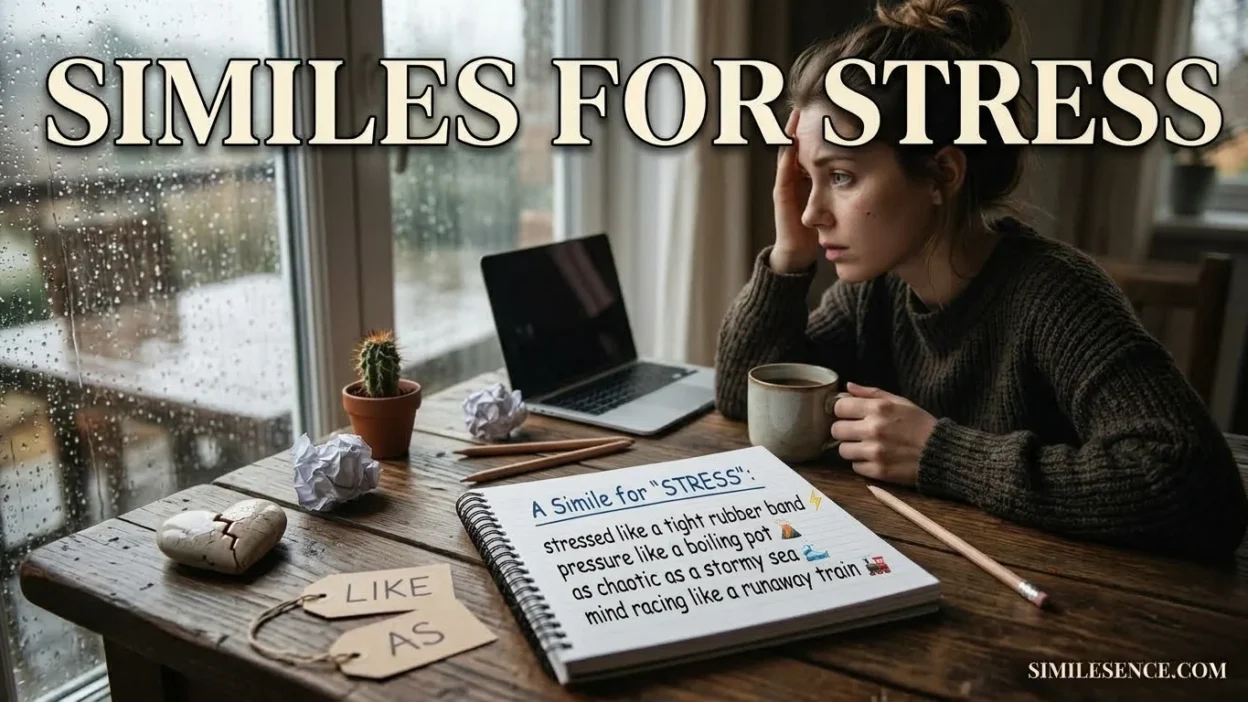
Have you ever felt so stressed that your thoughts seemed to race around your head? Maybe you had too much work, too many worries, or a problem you could not stop thinking about. Sometimes, simply saying “I am stressed” does not fully describe the feeling. This is where similes can help.
A simile compares one thing to another using words such as “like” or “as.” For example, you might say, “My mind was like a storm.” This comparison gives the reader a clearer picture of what stress feels like.
Using creative writing similes can make your words more colorful, emotional, and memorable. Instead of only telling readers that someone is stressed, you can show them the pressure, worry, or tension through an image they can understand.
In simple terms, similes help turn feelings into pictures. Let’s explore some useful similes for stress and see how you can use them in everyday writing.
20 Similes for Stress
1. My mind was like a storm
Meaning: This means your thoughts were confused, busy, and difficult to control.
What it conveys: It creates a strong picture of racing or troubling thoughts.
Example sentences:
- Before the exam, my mind was like a storm.
- With so many decisions to make, her mind felt like a storm.
2. I felt as tense as a stretched rubber band
Meaning: This describes someone who feels extremely tense and close to their limit.
What it conveys: It shows how stress can make your body and emotions feel tight.
Example sentences:
- After working all day, I felt as tense as a stretched rubber band.
- He was as tense as a stretched rubber band while waiting for the results.
3. Stress weighed on me like a heavy backpack
Meaning: This means stress felt like a heavy burden.
What it conveys: It shows that worries can become tiring over time.
Example sentences:
- The unfinished work weighed on me like a heavy backpack.
- Her responsibilities felt like a heavy backpack she carried everywhere.
4. My thoughts raced like speeding cars
Meaning: This means your thoughts were moving very quickly.
What it conveys: It helps readers imagine a mind that will not slow down.
Example sentences:
- My thoughts raced like speeding cars when I could not sleep.
- His thoughts were like speeding cars before the important meeting.
5. I was as nervous as a cat in a room full of dogs
Meaning: This describes feeling extremely nervous or unsafe.
What it conveys: It creates a clear image of fear and discomfort.
Example sentences:
- Before giving my speech, I was as nervous as a cat in a room full of dogs.
- She felt as nervous as a cat in a room full of dogs during her first interview.
6. Stress was like a shadow following me
Meaning: This means stress seemed to stay with you wherever you went.
What it conveys: It shows that worries can be difficult to escape.
Example sentences:
- Work stress was like a shadow following me all weekend.
- His worries were like a shadow following him throughout the day.
7. I felt trapped like a bird in a cage
Meaning: This describes feeling stuck or unable to find a solution.
What it conveys: It expresses emotional pressure and a lack of freedom.
Example sentences:
- With so many problems around me, I felt trapped like a bird in a cage.
- She felt like a bird in a cage when every choice seemed impossible.
8. My worries piled up like mountains
Meaning: This means problems seemed to grow larger and larger.
What it conveys: It shows how several small worries can become overwhelming.
Example sentences:
- My worries piled up like mountains before the deadline.
- His unfinished tasks piled up like mountains on his desk.
9. I was as busy as a bee in a storm
Meaning: This describes someone who is extremely busy while also dealing with confusion or pressure.
What it conveys: It combines constant activity with stress.
Example sentences:
- I was as busy as a bee in a storm trying to finish everything.
- She was as busy as a bee in a storm before the event.
10. My nerves were like a ticking clock
Meaning: This means you felt tense while waiting for something to happen.
What it conveys: It creates a sense of pressure and anticipation.
Example sentences:
- My nerves were like a ticking clock before the announcement.
- His nerves felt like a ticking clock while he waited for the phone call.
11. Stress hit me like a wave
Meaning: This means stress suddenly became very strong.
What it conveys: It shows how powerful and unexpected stress can feel.
Example sentences:
- When I saw the amount of work left, stress hit me like a wave.
- The news hit her like a wave and left her speechless.
12. My head was buzzing like a busy marketplace
Meaning: This means your mind was filled with many thoughts and distractions.
What it conveys: It creates a lively picture of mental noise.
Example sentences:
- After the long meeting, my head was buzzing like a busy marketplace.
- I could not sleep because my mind was buzzing like a busy marketplace.
13. I felt like a pressure cooker
Meaning: This means emotions and stress were building up inside you.
What it conveys: It suggests that too much pressure may eventually lead to an emotional release.
Example sentences:
- After keeping everything inside, I felt like a pressure cooker.
- He had so much work that he felt like a pressure cooker ready to burst.
14. My stress was as heavy as a pile of bricks
Meaning: This describes stress that feels physically and emotionally exhausting.
What it conveys: It emphasizes the weight of worry.
Example sentences:
- By Friday, my stress felt as heavy as a pile of bricks.
- The responsibility was as heavy as a pile of bricks on her shoulders.
15. My mind spun like a wheel
Meaning: This means you kept thinking about the same problems without finding an answer.
What it conveys: It shows endless and repetitive thinking.
Example sentences:
- My mind spun like a wheel as I tried to solve the problem.
- Her mind was spinning like a wheel before bedtime.
16. I was as restless as a fish out of water
Meaning: This means you felt uncomfortable, worried, or unable to relax.
What it conveys: It gives a strong picture of emotional discomfort.
Example sentences:
- I was as restless as a fish out of water before the exam.
- He felt as restless as a fish out of water while waiting for the news.
17. Worry clung to me like wet clothes
Meaning: This means worry stayed with you and was difficult to shake off.
What it conveys: It makes stress feel persistent and uncomfortable.
Example sentences:
- The thought of tomorrow clung to me like wet clothes.
- Her worries clung to her like wet clothes all evening.
18. I felt like I was carrying the world on my shoulders
Meaning: This means you felt responsible for too many things at once.
What it conveys: It shows emotional pressure and a heavy sense of responsibility.
Example sentences:
- With work, family, and bills to manage, I felt like I was carrying the world on my shoulders.
- He looked exhausted, as if he were carrying the world on his shoulders.
19. My stress grew like a fire
Meaning: This means stress became stronger as time passed.
What it conveys: It shows how pressure can grow when it is not addressed.
Example sentences:
- As the deadline came closer, my stress grew like a fire.
- Her worry grew like a fire after she received the unexpected message.
20. My emotions were like a stormy sea
Meaning: This means your emotions were changing quickly and felt difficult to control.
What it conveys: It creates a vivid image of emotional confusion and turbulence.
Example sentences:
- During that difficult week, my emotions were like a stormy sea.
- His emotions felt like a stormy sea after the stressful conversation.
How to Use Similes for Stress in Writing
When you use similes in writing, think about the exact feeling you want your reader to experience. Stress can feel heavy, fast, loud, confusing, frightening, or exhausting. Choose a comparison that matches that feeling.
For example, if a character has too many thoughts, you might write:
“Her thoughts raced like speeding cars.”
If the character feels overwhelmed by responsibility, you could write:
“He felt like he was carrying the world on his shoulders.”
You might also create your own comparisons. Think about objects, animals, weather, sounds, or places that remind you of stress. This simple technique can help you create fresh and natural simile sentences.
Practical Exercise: Identify and Complete the Similes
Try these questions before looking at the answers.
Questions
1. Complete the simile:
“My thoughts raced like ______.”
2. Which simile best describes feeling overwhelmed?
A. My stress was like a heavy backpack.
B. My smile was like sunshine.
C. My voice was like music.
3. What does this simile mean?
“Stress hit me like a wave.”
4. Complete the sentence:
“I felt trapped like a ______.”
5. Which comparison shows repeated, restless thinking?
A. My mind spun like a wheel.
B. My heart was like a flower.
C. My eyes were like stars.
6. What feeling does this simile describe?
“I was as tense as a stretched rubber band.”
7. Complete the simile:
“My worries piled up like ______.”
8. What does “stress was like a shadow following me” suggest?
9. Choose the best word:
“My emotions were like a ______ sea.”
A. stormy
B. quiet
C. empty
10. Create your own simile for stress using the word “like.”
Answers and Explanations
1. Speeding cars
“My thoughts raced like speeding cars.” This shows that thoughts are moving quickly.
2. A. My stress was like a heavy backpack.
A heavy backpack represents a burden, making it a useful comparison for stress.
3. It means stress suddenly became very strong.
The wave comparison shows how stress can arrive with force.
4. Bird in a cage
“I felt trapped like a bird in a cage.” This expresses feeling stuck or unable to escape a situation.
5. A. My mind spun like a wheel.
A spinning wheel represents thoughts that keep going around and around.
6. It describes strong tension.
A stretched rubber band is tight, so the comparison helps readers understand how tense someone feels.
7. Mountains
“My worries piled up like mountains.” This suggests that worries became large and overwhelming.
8. It suggests that stress stayed with the person.
The shadow represents something that follows you wherever you go.
9. A. Stormy
“My emotions were like a stormy sea” suggests strong, changing, and difficult emotions.
10. Answers will vary.
For example: “My stress was like a heavy cloud hanging over me.” The goal is to create a comparison that clearly communicates the feeling.
Conclusion
Similes are a simple but powerful way to make writing more expressive. Instead of simply telling readers that someone is stressed, you can show what that stress feels like through a clear comparison.
The best similes for stress help readers picture racing thoughts, heavy responsibilities, nervous feelings, and emotional pressure. They can make stories, poems, essays, and everyday writing more vivid and interesting.
As you practice, do not worry about making every comparison perfect. Start with something familiar. Think about how stress feels to you, then compare it to an object, animal, place, sound, or natural event.
Try writing a few creative writing similes of your own. With practice, you will become more confident in understanding the meaning of similes and knowing how to use similes in writing.

Sophia Taylor is a passionate language writer specializing in similes, idioms, and metaphors. She creates engaging, easy-to-understand content that helps readers explore figurative language, improve communication skills, and enjoy the beauty of English expressions.