
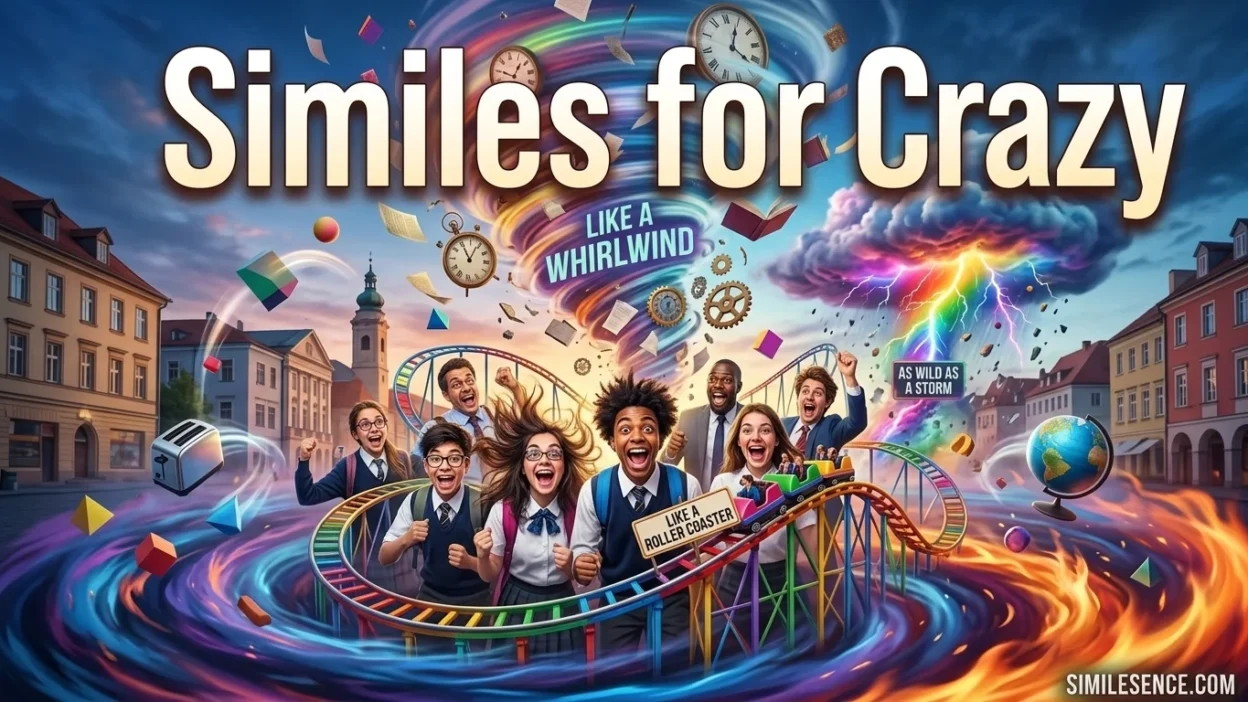
Have you ever wanted to describe someone or something as crazy, but “crazy” felt too simple? That is where similes can make your writing much more interesting. A simile compares two different things using words such as “like” or “as.” It helps readers picture an idea instead of simply being told about it.
For example, saying “He was crazy” gives us only a basic idea. But saying “He was as wild as a storm” creates a stronger picture in the reader’s mind.
In simple terms, similes turn plain words into vivid images. They can make stories, poems, conversations, and creative writing more colorful and fun. The meaning of similes can also change with the comparison you choose. “Crazy like a monkey” can sound playful, while “crazy like a tornado” can suggest wild and uncontrollable behavior.
Let’s explore 20 creative similes for crazy, along with their meanings and simple simile sentences you can use in your own writing.
20 Similes for Crazy
1. Crazy Like a Monkey
Simile: He was acting crazy like a monkey.
Meaning: This describes someone behaving in a very wild, playful, or energetic way.
What it conveys: The comparison creates a funny picture of someone jumping around or behaving without much control.
Examples:
- The kids went crazy like monkeys when the music started.
- He was running around crazy like a monkey at the party.
2. Crazy Like a Tornado
Simile: She moved around the room like a tornado.
Meaning: It describes someone or something moving wildly and causing lots of activity.
What it conveys: A tornado suggests speed, energy, and chaos.
Examples:
- He cleaned the house like a tornado had hit it.
- The children raced through the yard like a tornado.
3. Crazy Like a Wild Animal
Simile: He fought like a wild animal.
Meaning: This suggests someone is acting fiercely, wildly, or without calm control.
What it conveys: The comparison makes the behavior seem intense and uncontrolled.
Examples:
- The angry player shouted like a wild animal.
- He ran through the forest like a wild animal.
4. Crazy as a Hatter
Simile: He was as crazy as a hatter.
Meaning: This is a traditional expression meaning someone seems very strange or eccentric.
What it conveys: It gives writing an old-fashioned and humorous feeling.
Examples:
- Everyone thought the old inventor was as crazy as a hatter.
- My uncle can be as crazy as a hatter when he tells stories.
5. Crazy Like a Fox
Simile: She was crazy like a fox.
Meaning: This can suggest someone seems strange but may actually be clever.
What it conveys: The fox often represents cleverness, so the phrase can have a playful double meaning.
Examples:
- His plan sounded crazy like a fox, but it worked.
- She seemed crazy like a fox, yet she knew exactly what she was doing.
6. Crazy Like a Firework
Simile: The crowd became crazy like fireworks exploding in the sky.
Meaning: It describes sudden excitement, energy, and noise.
What it conveys: Fireworks suggest bursts of action and excitement.
Examples:
- The fans went crazy like fireworks after the final goal.
- The children became crazy like fireworks when the presents arrived.
7. Crazy Like a Roller Coaster
Simile: My thoughts were crazy like a roller coaster.
Meaning: This describes thoughts or emotions that move quickly and unpredictably.
What it conveys: A roller coaster suggests sudden changes and emotional ups and downs.
Examples:
- Her emotions were crazy like a roller coaster that day.
- My mind felt crazy like a roller coaster before the exam.
8. Crazy as a Storm
Simile: The night was as crazy as a storm.
Meaning: This describes a situation that is noisy, wild, or difficult to control.
What it conveys: A storm creates an image of powerful and chaotic activity.
Examples:
- The party became as crazy as a storm.
- The classroom was as crazy as a storm before the teacher arrived.
9. Crazy Like a Spinning Top
Simile: He was running around like a spinning top.
Meaning: It describes someone who cannot seem to stop moving.
What it conveys: A spinning top suggests constant motion and restless energy.
Examples:
- The little boy ran around like a spinning top.
- She was moving from one task to another like a spinning top.
10. Crazy as a March Hare
Simile: He was as crazy as a March hare.
Meaning: This means someone is acting extremely excited, strange, or energetic.
What it conveys: The expression has a playful and literary feel.
Examples:
- The children were as crazy as March hares after school.
- He danced around the room as crazy as a March hare.
11. Crazy Like a Rocket
Simile: He took off like a rocket.
Meaning: This describes someone moving or reacting very quickly.
What it conveys: A rocket suggests speed, force, and sudden action.
Examples:
- She ran like a rocket when she heard the bell.
- The excited puppy jumped around like a rocket.
12. Crazy Like a Whirlwind
Simile: She entered the kitchen like a whirlwind.
Meaning: This describes someone who moves quickly and energetically.
What it conveys: A whirlwind suggests fast, powerful, and chaotic movement.
Examples:
- Mom rushed around the house like a whirlwind.
- The little boy moved through the room like a whirlwind.
13. Crazy as a Bouncing Ball
Simile: The child was as crazy as a bouncing ball.
Meaning: It describes someone who is full of restless energy.
What it conveys: A bouncing ball gives the reader an image of someone who keeps moving.
Examples:
- The puppy was as crazy as a bouncing ball.
- He became as crazy as a bouncing ball after drinking soda.
14. Crazy Like a Broken Compass
Simile: My thoughts were spinning like a broken compass.
Meaning: This suggests confusion, disorder, or thoughts that seem to have no clear direction.
What it conveys: A broken compass cannot guide someone properly, making it a useful image for mental confusion.
Examples:
- Before the test, my thoughts spun like a broken compass.
- His ideas seemed to move like a broken compass.
15. Crazy as a Thunderstorm
Simile: The celebration was as crazy as a thunderstorm.
Meaning: It describes a loud, energetic, and chaotic event.
What it conveys: Thunder and lightning create a strong image of noise and excitement.
Examples:
- The stadium was as crazy as a thunderstorm.
- The party became as crazy as a thunderstorm after midnight.
16. Crazy Like a Monkey on a Trampoline
Simile: He jumped around like a monkey on a trampoline.
Meaning: This describes someone who is extremely energetic and playful.
What it conveys: The comparison creates a funny and exaggerated image.
Examples:
- The children bounced around like monkeys on a trampoline.
- He was jumping like a monkey on a trampoline after winning the game.
17. Crazy as a Squirrel in a Maze
Simile: She was as restless as a squirrel in a maze.
Meaning: This describes someone who seems confused, nervous, or unable to settle down.
What it conveys: The image combines nervous energy with confusion.
Examples:
- He looked as restless as a squirrel in a maze.
- Before his speech, he paced around like a squirrel in a maze.
18. Crazy Like a Lightning Bolt
Simile: The idea hit me like a lightning bolt.
Meaning: This describes something sudden, powerful, and surprising.
What it conveys: Lightning suggests speed and unexpected energy.
Examples:
- Her crazy idea struck me like a lightning bolt.
- The sudden plan came like a lightning bolt.
19. Crazy as a Carnival
Simile: The street was as crazy as a carnival.
Meaning: This describes a place filled with noise, excitement, movement, and fun.
What it conveys: A carnival creates a colorful image of energetic activity.
Examples:
- The festival was as crazy as a carnival.
- Our classroom became as crazy as a carnival during the celebration.
20. Crazy Like a Wild Roller Coaster
Simile: My day was crazy like a wild roller coaster.
Meaning: This describes a day filled with unexpected events and rapid changes.
What it conveys: The roller coaster comparison shows excitement, surprises, and emotional ups and downs.
Examples:
- Yesterday was crazy like a wild roller coaster.
- Her week had been crazy like a wild roller coaster.
How to Use Similes for Crazy in Writing
When using similes for crazy, think about the exact feeling you want to create. Do you want your character to seem funny, energetic, confused, excited, or completely out of control?
For example, “crazy like a monkey” sounds playful. “crazy like a tornado” sounds chaotic. “crazy like a roller coaster” can describe unpredictable thoughts or emotions.
You might say:
“The party was crazy like a carnival.”
This gives the reader a clear picture of a loud and exciting event.
When creating your own creative writing similes, start with the feeling you want to describe. Then choose something that strongly shows that feeling. This makes your simile sentences more natural and memorable.
Practical Exercise: Test Your Simile Skills
Try these questions before checking the answers.
Questions
1. Complete the simile:
He was running around like a ________.
2. Which comparison best describes a chaotic situation?
A. like a tornado
B. like a pillow
C. like a candle
3. Complete the sentence:
Her thoughts were like a ________ roller coaster.
4. What does “crazy like a monkey” usually suggest?
5. Which simile suggests sudden speed?
A. like a rocket
B. like a stone
C. like a cloud
6. Complete the simile:
The party was as crazy as a ________.
7. What does “crazy like a whirlwind” convey?
8. Which simile is best for someone who keeps changing direction mentally?
A. like a broken compass
B. like a sleeping cat
C. like a quiet lake
9. Write your own simile for someone who is extremely energetic.
10. Identify the simile:
“The classroom was as crazy as a storm.”
Answers and Explanations
1. Answer: Monkey, tornado, or another suitable comparison.
Explanation: A simile compares two things. The best answer depends on the feeling you want to create.
2. Answer: A. like a tornado
Explanation: A tornado suggests disorder, speed, and powerful movement.
3. Answer: Wild.
Explanation: “Like a wild roller coaster” suggests sudden changes and strong emotions.
4. Answer: It suggests playful, wild, or energetic behavior.
Explanation: The monkey comparison creates a funny and lively image.
5. Answer: A. like a rocket
Explanation: Rockets are associated with very fast movement.
6. Answer: Carnival or storm.
Explanation: Both can suggest noise, energy, and excitement.
7. Answer: It conveys fast, energetic, and chaotic movement.
Explanation: A whirlwind moves quickly and unpredictably.
8. Answer: A. like a broken compass
Explanation: A broken compass suggests a lack of clear direction.
9. Answer: Answers will vary.
Example: “He was energetic like a bouncing ball.”
Explanation: A bouncing ball creates a clear picture of constant movement.
10. Answer: “As crazy as a storm.”
Explanation: The words “as” and “as” create the simile and compare the classroom to a storm.
Conclusion
Similes are a simple but powerful way to make your writing more vivid. Instead of saying someone is simply “crazy,” you can compare their behavior to a tornado, monkey, whirlwind, rocket, or carnival. These comparisons help readers see and feel what you mean.
The best similes for crazy are not always the funniest ones. Choose a comparison that matches your message. If you want playful writing, use a lively image. If you want chaos, choose something powerful like a storm or tornado.
Now that you know how similes work, try creating a few of your own. Think about the feeling you want to show, choose a strong image, and connect the two with “like” or “as.” With practice, your simile sentences can make every story more colorful and memorable.

Henry Gavin is the Administrator of SimileSence, ensuring high-quality content about similes, idioms, and metaphors. He manages daily operations, supports editorial excellence, and helps readers explore figurative language with confidence.