
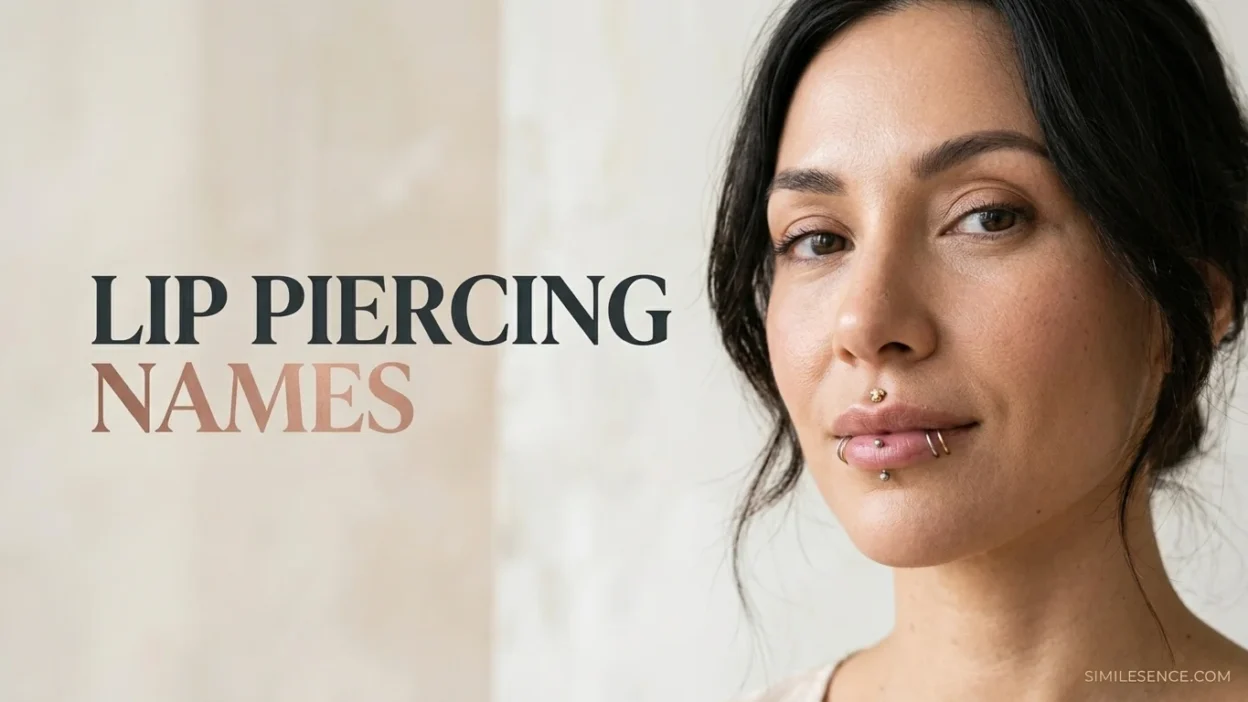
Different lip piercing names describe unique placements around the mouth, from a simple labret piercing beneath the lower lip to bold combinations such as snake bites, angel bites, and shark bites. Some piercings sit above the upper lip, others pass through the lip itself, and paired styles create symmetrical or alternative looks. Understanding their locations, jewelry options, and potential risks can help you choose a style that matches your preferences.
Quick Answer
Popular lip piercing types include the labret, side labret, vertical labret, Monroe, Madonna, Medusa, Jestrum, Ashley, snake bites, spider bites, dolphin bites, angel bites, Dahlia, cyber bites, shark bites, and canine bites. Each style differs in placement and appearance. Your anatomy, jewelry fit, oral health, and professional piercer’s advice should guide your final choice.
What Are Lip Piercings?
Lip piercings are body piercings placed through the lips or in the surrounding tissue. They can be centered, positioned to one side, or arranged in pairs and combinations. The result can be subtle and minimalist or bold and highly decorative.
Some lip piercings pass through the lip tissue, while others enter from the outside and exit inside the mouth. This difference affects the type of jewelry required, healing, and potential contact with teeth and gums.
People choose different types of lip piercings to:
- Express their personal style and individuality.
- Add a subtle accent or create a bold alternative look.
- Experiment with lip piercing jewelry, including studs, rings, and curved barbells.
- Combine multiple piercings for a customized appearance.
- Create symmetrical arrangements around the upper or lower lip.
Before choosing a piercing, learn its correct name and placement. Two styles may look similar but require different jewelry or involve different risks.
18 Popular Lip Piercing Names and Their Locations
The following guide covers popular lip piercings, less common placements, and multiple-piercing combinations.
1. Labret Piercing
A labret piercing is one of the best-known lower-lip piercings. It is usually positioned in the center, just below the lower lip.
Location: Centered beneath the lower lip.
Common jewelry: Flat-back labret studs and, when appropriate for the placement and healing stage, rings.
Appearance: Classic, balanced, and versatile.
The traditional labret is a popular choice for people who want a single piercing without committing to a more elaborate arrangement. Its simple placement also makes it easy to combine with other facial piercings.
A professional piercer should assess the position carefully to minimize contact between the jewelry and your teeth or gums.
2. Side Labret Piercing
A side labret piercing sits below the lower lip but is positioned to the left or right of the center.
Location: Off-center beneath the lower lip.
Common jewelry: Flat-back studs or suitable rings.
Appearance: Asymmetrical and understated.
The main difference between a traditional labret and a side labret is placement. A centered labret creates a balanced look, while a side labret draws attention to one side of the mouth.
This style may appeal to someone who wants a single piercing with a little more visual character.
3. Vertical Labret Piercing
A vertical labret piercing passes vertically through the lower lip. One end of the jewelry appears near the upper surface of the lip, while the other sits below it.
Location: Through the lower lip vertically.
Common jewelry: Curved barbell.
Appearance: Noticeable jewelry on the lip itself.
Unlike a traditional labret, a vertical labret generally does not have an end inside the mouth. However, it still needs professional placement, suitable jewelry, and consistent aftercare.
4. Monroe Piercing
A Monroe piercing sits above the upper lip on the wearer’s left side. Its name refers to the beauty mark associated with Marilyn Monroe.
Location: Above the left side of the upper lip.
Common jewelry: Small flat-back stud.
Appearance: Elegant, subtle, and recognizable.
The Monroe is a popular option for someone who wants a single upper-lip accent. A small decorative end or gemstone can personalize the appearance, provided the jewelry is suitable for the piercing.
5. Madonna Piercing
A Madonna piercing resembles a Monroe piercing but sits above the upper lip on the wearer’s right side.
Location: Above the right side of the upper lip.
Common jewelry: Small stud.
Appearance: Simple and asymmetrical.
The key distinction between the Monroe and Madonna is the side of the face. Some people choose one, while others combine both to create angel bites.
6. Medusa Piercing
A Medusa piercing, also called a philtrum piercing, sits in the groove between the base of the nose and the center of the upper lip.
Location: Center of the philtrum, above the upper lip.
Common jewelry: Flat-back labret stud.
Appearance: Centered and symmetrical.
The Medusa is a popular option for people who prefer a centered upper-lip piercing. Its placement makes jewelry selection especially important because an improperly fitted stud can irritate the surrounding tissue.
Because the jewelry may contact the inside of the mouth, ask your piercer how the placement could affect your teeth and gums.
7. Jestrum Piercing
A Jestrum piercing, sometimes called a vertical Medusa, passes vertically through the upper lip.
Location: Through the center of the upper lip, with an exit near the philtrum.
Common jewelry: Curved barbell.
Appearance: Two visible ends that frame the upper lip.
The Jestrum differs from a standard Medusa because the jewelry passes through the lip rather than exiting inside the mouth.
Precise placement is important for a balanced appearance. A professional piercer can determine whether your upper-lip anatomy is suitable.
8. Ashley Piercing
An Ashley piercing passes through the front of the lower lip and exits inside the mouth. It is generally positioned near the center of the lip.
Location: Through the lower lip, typically near the center.
Common jewelry: A properly fitted flat-back labret stud.
Appearance: One visible decorative end on the lower lip.
Sometimes described as an inverse vertical labret, the Ashley creates a distinctive look because the outer end sits directly on the lip. However, its placement may expose the teeth and gums to jewelry contact.
Discuss swelling, jewelry length, and oral-health risks with your piercer before choosing this style.
9. Snake Bites Piercing
Snake bites consist of two piercings positioned on opposite sides of the lower lip.
Location: One piercing on each side of the lower lip.
Common jewelry: Two studs or suitable rings.
Appearance: Symmetrical and bold.
Snake bites are among the most recognizable paired lip piercings. The two points create a fang-like appearance, especially when fitted with appropriate rings.
You can choose matching jewelry for a balanced look or different decorative ends for a customized style. Both piercings require individual care during healing.
10. Spider Bites Piercing
Spider bites consist of two closely spaced piercings on one side of the lower lip.
Location: Two piercings close together on the left or right side.
Common jewelry: Small studs or suitable rings.
Appearance: Compact and asymmetrical.
Spider bites differ from snake bites because both piercings sit on the same side. Their close spacing gives them a distinctive appearance without requiring piercings on both sides of the mouth.
The available tissue and distance from the teeth and gums should influence the placement.
11. Dolphin Bites Piercing
Dolphin bites generally consist of two closely spaced piercings near the center of the lower lip.
Location: Close together near the central lower-lip area.
Common jewelry: Two small studs or suitable rings.
Appearance: Minimalist, centered, and symmetrical.
Dolphin bites offer an alternative to snake bites for people who prefer two lower-lip piercings closer together.
Piercing terminology can vary between studios and communities, so confirm the exact placement with your piercer before booking.
12. Angel Bites Piercing
Angel bites combine a Monroe-style piercing above the left side of the upper lip with a Madonna-style piercing above the right side.
Location: One piercing above each side of the upper lip.
Common jewelry: Two small studs.
Appearance: Symmetrical and decorative.
Angel bites are sometimes described as the upper-lip equivalent of snake bites. They create a balanced appearance while keeping the jewelry above the lip rather than beneath it.
If you like symmetrical facial jewelry, this combination may be worth considering.
13. Canine Bites Piercing
Canine bites combine four piercings: two above the upper lip and two around the lower lip.
Location: Two upper-lip piercings and two lower-lip piercings.
Common jewelry: Four appropriately fitted studs or a suitable combination of studs and rings.
Appearance: Bold and highly customized.
Canine bites combine the visual effect of angel bites and snake bites. Because the arrangement involves several piercings, swelling and aftercare can be more challenging.
A professional should assess the proposed placement of all four piercings rather than treating the combination as a one-size-fits-all option.
14. Shark Bites Piercing
Shark bites generally consist of four lower-lip piercings arranged as two closely spaced piercings on each side.
Location: Two piercings on the left and two on the right side of the lower lip.
Common jewelry: Small studs or suitable rings.
Appearance: Layered, symmetrical, and dramatic.
Shark bites create a fuller arrangement than snake bites. Their paired placement resembles rows of teeth, which explains the name.
Because the jewelry sits close together, careful spacing and suitable jewelry sizes are essential.
15. Dahlia Piercing
Dahlia piercings, also called Joker piercings, are positioned near the corners of the mouth.
Location: One piercing near each mouth corner.
Common jewelry: Small studs.
Appearance: A smile-framing arrangement.
Although often grouped with lip piercings, Dahlia piercings involve the tissue around the mouth corners rather than the lip itself. The area moves frequently during talking, eating, and smiling, making placement particularly important.
The name is sometimes associated with the Joker character because the jewelry can emphasize the corners of the mouth. The exact origins of the piercing’s name are not firmly established, so dramatic historical explanations should be treated cautiously.
16. Cyber Bites Piercing
Cyber bites combine two separate piercing styles: a Medusa above the upper lip and a labret beneath the lower lip.
Location: Centered above and below the lips.
Common jewelry: A suitable stud for each piercing.
Appearance: Symmetrical and vertically balanced.
This combination appeals to people who want more than one piercing while maintaining a centered design.
Because the two piercings sit in different areas, each needs an individual assessment for anatomy, jewelry fit, and oral-health risks.
17. Lowbret Piercing
A lowbret piercing sits below the lower lip, lower than a traditional labret.
Location: Lower area beneath the lower lip.
Common jewelry: Professionally fitted flat-back jewelry.
Appearance: A low-set lower-lip accent.
The lowbret is less common than a traditional labret. Its suitability depends on the available tissue and the distance between the jewelry and surrounding structures.
Ask a professional to evaluate the placement carefully, particularly if the jewelry could press against the gums or teeth.
18. Horizontal Lip Piercing
A horizontal lip piercing passes horizontally through part of the lip, producing two visible ends.
Location: Horizontally through the lip tissue.
Common jewelry: Specialized jewelry selected for the placement.
Appearance: A distinctive line of jewelry across the lip.
Horizontal lip piercings can have a greater risk of migration, rejection, and irritation than some conventional placements. Not every lip shape is suitable for this style.
Consult an experienced piercer who can explain the risks and assess whether the placement is appropriate for your anatomy.
Lip Piercing Names Compared
Use this comparison table to quickly identify popular lip piercing styles and their typical jewelry.
| Lip piercing name | Main location | Typical jewelry |
| Labret | Center beneath lower lip | Flat-back stud |
| Side labret | Off-center beneath lower lip | Stud or ring |
| Vertical labret | Vertically through lower lip | Curved barbell |
| Monroe | Above left side of upper lip | Stud |
| Madonna | Above right side of upper lip | Stud |
| Medusa | Center of philtrum | Flat-back stud |
| Jestrum | Vertically through upper lip | Curved barbell |
| Ashley | Through lower lip | Flat-back stud |
| Snake bites | Both sides of lower lip | Studs or rings |
| Spider bites | Two close piercings on one side | Studs or rings |
| Dolphin bites | Close together near lower-lip center | Two studs |
| Angel bites | Both sides above upper lip | Two studs |
| Canine bites | Two upper and two lower | Four pieces of jewelry |
| Shark bites | Two pairs on lower lip | Studs or rings |
| Dahlia | Near both mouth corners | Studs |
| Cyber bites | Medusa plus labret | Two suitable studs |
| Lowbret | Low beneath lower lip | Flat-back jewelry |
| Horizontal lip | Horizontally through lip tissue | Specialized jewelry |
These jewelry options are general examples, not universal recommendations. A professional piercer should choose the material, shape, and size based on the precise piercing and its healing stage.
Different Types of Lip Piercings by Placement
Understanding placement is often easier than memorizing every piercing name.
Upper Lip Piercings
Upper lip piercings include the Monroe, Madonna, Medusa, Jestrum, and angel bites.
- Choose a Monroe for a single piercing above the left side.
- Choose a Madonna for a single piercing above the right side.
- Consider a Medusa for a centered philtrum piercing.
- Explore a Jestrum for a vertical upper-lip placement.
- Consider angel bites for symmetrical upper-lip jewelry.
The main differences are the location of the entry and exit points and whether the piercing passes through the lip.
Lower Lip Piercings
Lower lip piercings include the labret, side labret, vertical labret, Ashley, snake bites, spider bites, dolphin bites, and shark bites.
- A labret is centered beneath the lower lip.
- A side labret sits to one side.
- A vertical labret passes through the lower lip.
- An Ashley exits inside the mouth.
- Snake bites use opposite sides of the lower lip.
- Spider bites use two close piercings on one side.
- Dolphin bites use two close piercings near the center.
- Shark bites use two pairs on the lower lip.
The right choice depends on your desired appearance and whether the jewelry will contact your teeth or gums.
Multiple Lip Piercings and Combinations
Some people combine different types of lip piercings to create a more personalized look.
Examples include:
- Angel bites and snake bites: Upper- and lower-lip pairs.
- Cyber bites: A Medusa and a labret.
- Canine bites: Four piercings around the mouth.
- Custom combinations: A centered piercing paired with an off-center style.
Multiple piercings can increase swelling, discomfort, and the demands of aftercare. A professional piercer can help you plan a suitable arrangement and determine whether the piercings should be performed at different appointments.
What Jewelry Is Used for Lip Piercings?

Choosing suitable lip piercing jewelry is just as important as choosing the piercing itself.
Labret Studs
Labret studs have a decorative front and a flat back. They are used for many traditional lip piercings, including the labret, Medusa, Monroe, and Madonna.
The initial stud must allow room for swelling. Once the piercing has healed and the swelling has settled, a qualified piercer can assess whether a shorter post is appropriate.
Lip Rings
Lip rings include captive bead rings and seamless or segment-style rings. They can create a circular accent around the lip.
However, rings are not appropriate for every placement or fresh piercing. The diameter, shape, and movement of the jewelry must suit the piercing’s anatomy.
Curved Barbells
Curved barbells are commonly used for vertical labret and Jestrum piercings because their shape follows the vertical path of the jewelry.
Using an unsuitable barbell can create pressure or irritation, so jewelry should be selected specifically for the placement.
Jewelry Materials
A reputable piercer can explain suitable materials, including verified implant-grade titanium and appropriate solid gold jewelry.
Avoid choosing jewelry solely by appearance or price. Material quality, surface finish, correct sizing, and professional fitting all matter.
How to Choose the Right Lip Piercing

The best lip piercing for you depends on your style, anatomy, oral health, and daily routine.
1. Match the Piercing to Your Style
If you prefer a minimalist look, consider a labret, Monroe, or Medusa. If you like symmetrical jewelry, explore snake bites or angel bites. For a more elaborate appearance, ask about shark bites, canine bites, or a custom combination.
These are starting points rather than rules. Your piercer can help you find a placement that works with your anatomy.
2. Consider Pain and Healing
Pain varies from person to person and depends on the placement, technique, and individual sensitivity. No lip piercing can be guaranteed to be painless.
Healing also varies. Some piercings settle within several weeks, while others take several months or longer. Multiple fresh piercings can make swelling and aftercare more demanding.
Ask your piercer about expected healing, follow-up appointments, and when jewelry changes may be appropriate.
3. Protect Your Teeth and Gums
Piercings with jewelry inside the mouth can rub against teeth or gums. Repeated contact may contribute to chipped teeth, enamel wear, gum recession, or irritation.
Ask your piercer how the jewelry will sit when you speak, smile, and eat. Regular dental checkups can help identify oral-health problems early.
If you notice tooth sensitivity, damaged enamel, or changes in your gums, seek advice from a dental professional.
4. Choose a Reputable Piercing Studio
Before booking, look for a studio that follows appropriate hygiene and sterilization practices.
A qualified piercer should:
- Use sterile, single-use needles and appropriate equipment.
- Explain the piercing process and possible complications.
- Assess your anatomy before recommending a placement.
- Use properly fitted, high-quality jewelry.
- Provide clear aftercare instructions.
- Answer questions without dismissing concerns.
Avoid anyone who guarantees a risk-free piercing or encourages you to ignore signs of complications.
Lip Piercing Healing and Aftercare
Proper lip piercing aftercare helps reduce irritation and supports healing.
Follow the instructions from your professional piercer. General precautions include:
- Wash your hands before touching the piercing.
- Clean the external area with sterile saline as directed.
- Maintain good oral hygiene for piercings that open into the mouth.
- Avoid twisting, pulling, or unnecessarily moving the jewelry.
- Avoid harsh cleaning products, alcohol, and hydrogen peroxide on the piercing.
- Do not change jewelry prematurely.
- Avoid pressure, friction, and activities that repeatedly irritate the area.
- Attend recommended follow-up appointments.
Some tenderness, swelling, and mild bleeding can occur initially. However, worsening pain, increasing swelling, spreading redness, fever, or unusual thick discharge can indicate a complication and warrant medical assessment.
Seek urgent medical care for severe swelling, difficulty breathing or swallowing, or rapidly worsening symptoms. If you suspect an infection, do not remove the jewelry without guidance from a healthcare professional.
Frequently Asked Questions About Lip Piercing Names
What are the most popular lip piercing names?
Popular lip piercing names include labret, vertical labret, Monroe, Madonna, Medusa, Jestrum, Ashley, snake bites, spider bites, dolphin bites, angel bites, shark bites, and cyber bites. Each has a distinct placement and appearance.
What is the piercing above the upper lip called?
It depends on the location. A Monroe sits above the left side, a Madonna sits above the right side, and a Medusa sits in the center of the philtrum.
What is the piercing below the lower lip called?
A piercing centered beneath the lower lip is usually called a labret piercing. A piercing positioned lower than a traditional labret may be called a lowbret. A vertical labret passes through the lower lip itself.
What is the difference between snake bites and spider bites?
Snake bites consist of two piercings on opposite sides of the lower lip. Spider bites consist of two closely spaced piercings on one side.
Which lip piercing is best for beginners?
There is no universally best first lip piercing. A single labret, Monroe, or Medusa may appeal to someone seeking a simple style, but suitability depends on anatomy, oral health, jewelry fit, and professional assessment.
Do lip piercings damage your teeth?
They can. Jewelry that repeatedly contacts teeth or gums may contribute to enamel damage, chipped teeth, and gum recession. Proper placement and jewelry fitting can reduce some risks but cannot eliminate them.
How long does a lip piercing take to heal?
Healing time varies by placement and individual circumstances. Some piercings settle within several weeks, while others need several months or longer. Follow professional aftercare instructions and consult your piercer before changing jewelry.
Can you have multiple lip piercings at once?
Yes, combinations such as canine bites and shark bites are possible for suitable anatomy. However, multiple fresh piercings can increase swelling and aftercare demands. A professional piercer can help determine a suitable plan.
Final Thoughts
There are many types of lip piercings, ranging from the classic labret and subtle Monroe to the symmetrical snake bites and more elaborate shark bites or canine bites. Understanding each piercing’s location and jewelry requirements makes it easier to compare styles and choose one that fits your preferences.
Before making a decision, consider healing, jewelry fit, oral health, and your daily routine. Choose a reputable professional who can assess your anatomy, explain the risks, and provide appropriate aftercare guidance. The best piercing is not simply the most fashionable one; it is a style you can wear comfortably and care for responsibly.

Henry Gavin is the Administrator of SimileSence, ensuring high-quality content about similes, idioms, and metaphors. He manages daily operations, supports editorial excellence, and helps readers explore figurative language with confidence.