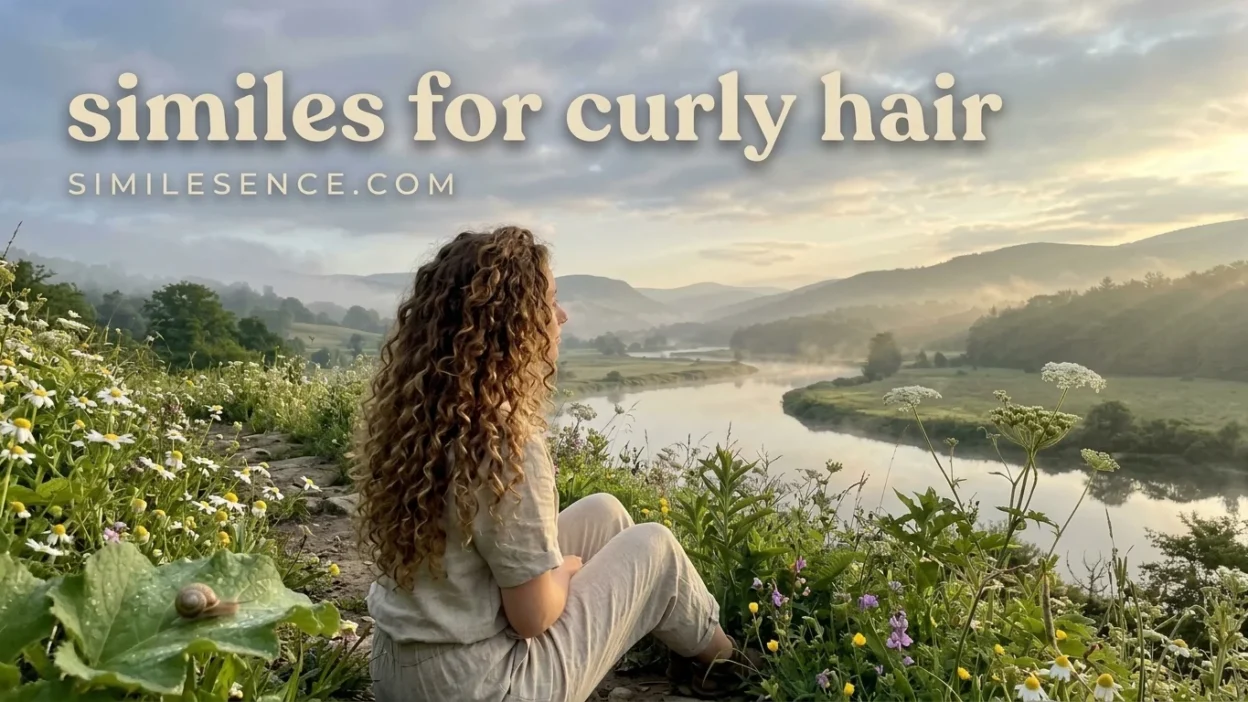
Have you ever looked at someone’s curly hair and thought, “Those curls look like…”? That simple thought can turn an ordinary description into a colorful piece of writing. That’s exactly what similes do. A simile compares one thing to another using words such as “like” or “as.”
When you’re describing curly hair, similes can make your words more vivid and fun. Instead of simply saying, “Her hair was curly,” you might say, “Her hair bounced like tiny springs.” Now, the reader can almost picture those lively curls.
In simple terms, similes help readers see, feel, and imagine what you are describing. They are especially useful in stories, poems, captions, school assignments, and creative writing.
Let’s explore some creative similes for curly hair that you can use in your own writing. Each example includes its meaning and simple simile sentences so you can understand how to use it naturally.
20 Similes for Curly Hair
1. Her hair was like a cloud of soft curls.
Meaning: Her hair looked full, fluffy, and soft.
This simile creates an image of thick, gentle curls that look light and fluffy.
Example sentences:
- Her hair was like a cloud of soft curls around her face.
- The little girl’s hair looked like a fluffy cloud.
2. His curls bounced like tiny springs.
Meaning: His curls were lively and moved back into shape.
This comparison makes curly hair seem energetic and playful.
Example sentences:
- His curls bounced like tiny springs as he ran.
- Every step made her curls bounce like little springs.
3. Her hair curled like winding vines.
Meaning: Her curls twisted and turned naturally.
This simile compares the shape of curly hair to vines growing in twisting patterns.
Example sentences:
- Her dark hair curled like winding vines.
- The curls around her face looked like delicate vines.
4. His curls were as soft as velvet.
Meaning: His hair felt extremely soft and smooth.
The comparison to velvet emphasizes the gentle texture of the curls.
Example sentences:
- His curls were as soft as velvet.
- I touched her hair, and it felt as soft as velvet.
5. Her curls danced like waves in the wind.
Meaning: Her curls moved freely and beautifully.
This simile gives curly hair a graceful and lively feeling.
Example sentences:
- Her curls danced like waves in the wind.
- As she walked, her hair moved like waves.
6. His hair was like a golden nest.
Meaning: His curly hair was thick, tangled, and full.
This comparison can create a warm and playful picture of textured curls.
Example sentences:
- His golden curls looked like a tiny nest.
- Her thick hair was curled around her head like a golden nest.
7. Her curls were as bouncy as rubber bands.
Meaning: Her curls were springy and full of movement.
This is a fun way to describe curls that quickly bounce back into shape.
Example sentences:
- Her curls were as bouncy as rubber bands.
- His hair sprang back as quickly as a rubber band.
8. His hair twisted like a spiral staircase.
Meaning: His curls had noticeable twists and spirals.
The comparison highlights the winding shape of tightly curled hair.
Example sentences:
- His curls twisted like a spiral staircase.
- Each curl looked like a tiny spiral staircase.
9. Her curly hair was like a crown.
Meaning: Her curls looked beautiful and made her appearance stand out.
This simile gives curly hair a proud and elegant feeling.
Example sentences:
- Her curls sat around her head like a beautiful crown.
- She wore her natural hair like a shining crown.
10. His curls were as wild as a jungle.
Meaning: His hair was very full, untamed, or naturally textured.
This comparison creates a bold and playful image.
Example sentences:
- His curls were as wild as a jungle.
- Her thick hair looked like a tiny jungle of curls.
11. Her hair wrapped around her face like ribbons.
Meaning: Her curls gently surrounded her face.
This simile makes the hairstyle sound soft, delicate, and beautiful.
Example sentences:
- Her curls wrapped around her face like ribbons.
- Soft strands fell around her cheeks like colorful ribbons.
12. His curls looked like little question marks.
Meaning: His curls had unusual curved shapes.
This is a playful comparison for curls that bend sharply.
Example sentences:
- His short curls looked like little question marks.
- Each curl curved over his forehead like a tiny question mark.
13. Her hair was as fluffy as cotton.
Meaning: Her hair looked very soft, thick, and fluffy.
This comparison focuses on the volume and softness of curly hair.
Example sentences:
- Her curls were as fluffy as cotton.
- His hair looked as soft and fluffy as cotton.
14. His curls spiraled like ocean waves.
Meaning: His curls formed smooth, flowing patterns.
This simile gives the hair a calm and natural appearance.
Example sentences:
- His curls spiraled like ocean waves.
- Her hair flowed around her shoulders like gentle waves.
15. Her curls sprang up like little flowers.
Meaning: Her curls were small, rounded, and full of life.
This comparison gives curly hair a cheerful and beautiful image.
Example sentences:
- Her curls sprang up like little flowers.
- Tiny curls covered her head like a garden of flowers.
16. His hair was like a fluffy halo.
Meaning: His curls surrounded his head in a soft, round shape.
This can suggest a beautiful and glowing appearance.
Example sentences:
- His curly hair formed a fluffy halo around his head.
- Her natural curls looked like a soft halo.
17. Her curls twisted like tiny ropes.
Meaning: Her hair had tight, defined twists.
This comparison works especially well when describing tightly curled or coiled hair.
Example sentences:
- Her curls twisted like tiny ropes.
- His carefully styled hair looked like rows of soft ropes.
18. His curls were as lively as dancing flames.
Meaning: His curls moved energetically and had a bold appearance.
This creates a strong visual image of active, flowing curls.
Example sentences:
- His curls were as lively as dancing flames.
- Her hair moved around her face like little flames.
19. Her curly hair fell like a waterfall.
Meaning: Her long curls flowed downward in a beautiful, continuous way.
This simile is useful for describing long, flowing curly hair.
Example sentences:
- Her long curls fell like a waterfall down her back.
- Dark curls flowed over her shoulders like a waterfall.
20. His curls were like tiny clouds after a storm.
Meaning: His hair looked full, soft, and slightly wild.
This comparison creates a dreamy and memorable image.
Example sentences:
- His curls looked like tiny clouds after a storm.
- Her soft hair formed little clouds around her face.
How to Use Similes in Writing
Using similes becomes easier when you first decide what quality of the hair you want to describe.
Do you want to show that the curls are:
- Soft?
- Bouncy?
- Thick?
- Wild?
- Long?
- Shiny?
- Tight?
- Flowing?
For example, if you want to show movement, you might say, “Her curls bounced like tiny springs.” If you want to describe softness, you could write, “Her curls were as soft as velvet.”
The best creative writing similes add a clear picture without making the sentence confusing. You might say that curly hair is “like a cloud,” but the comparison works best when the reader understands why it is like a cloud.
Practical Exercise: Test Your Simile Skills
Questions
1. Complete the simile:
Her curls bounced like ______.
2. Which word completes this simile naturally?
“Her hair was as soft as ______.”
A. velvet
B. thunder
C. stone
3. Identify the simile:
“His curls twisted like winding vines.”
4. What does this simile suggest?
“Her hair was like a fluffy cloud.”
5. Complete the sentence:
“His curls were as bouncy as ______.”
6. Which sentence uses a simile?
A. Her hair was curly.
B. Her curls bounced like springs.
C. Her hair was brown.
7. What is being compared in this sentence?
“Her curls danced like waves.”
8. Complete the simile:
“Her curls surrounded her face like ______.”
**9. Create your own simile for soft curly hair.
**10. Create your own simile for wild curly hair.
Answers
1. Tiny springs.
The comparison shows that the curls are springy and lively.
2. A. Velvet.
Velvet is known for being soft, so it creates a clear comparison.
3. “His curls twisted like winding vines.”
The word “like” signals the simile.
4.
It suggests that the hair looks soft, fluffy, and full.
5. Rubber bands.
Rubber bands can stretch and spring back, making them a good comparison for bouncy curls.
6. B. Her curls bounced like springs.
It compares curls to springs using the word “like.”
7.
The curls are compared to waves to show their flowing movement.
8. A fluffy halo.
This comparison suggests that the curls form a soft shape around the face.
9. Example answer:
“Her curls were as soft as velvet.”
This compares the softness of curly hair to velvet.
10. Example answer:
“His curls were as wild as a jungle.”
This creates a playful image of thick, untamed hair.
Conclusion
Similes can turn a simple description into something readers can easily picture. Instead of saying that someone has curly hair, you can describe those curls as bouncy springs, soft clouds, winding vines, or flowing waves. These comparisons make your writing more colorful and memorable.
The meaning of similes is simple: they help us explain one thing by comparing it to something familiar. Once you understand how they work, you can use them in stories, poems, captions, school assignments, and everyday writing.
So, don’t be afraid to experiment. Look at the curls you want to describe and ask yourself, “What do they remind me of?” That question can lead to your next great simile sentence.
John Kyle is a passionate writer specializing in similes, idioms, metaphors, and figurative language. He creates clear, engaging, and educational content that helps readers understand and confidently use English expressions.